CRM KitsChurches: volunteers, background check dates and training
Every step to serving, on the record and renewed on time.
A workspace for the church office that brings people onto its serving teams: the application, the conversation, the background check through your own screening provider, training, the volunteer policy, a shadow shift and a place on a team. Every volunteer is one row with each step in words, checks that have expired or expire within 60 days come first, and so does anyone serving with children or students with no completed check recorded. A background check is only a status and dates: the result stays with your provider.
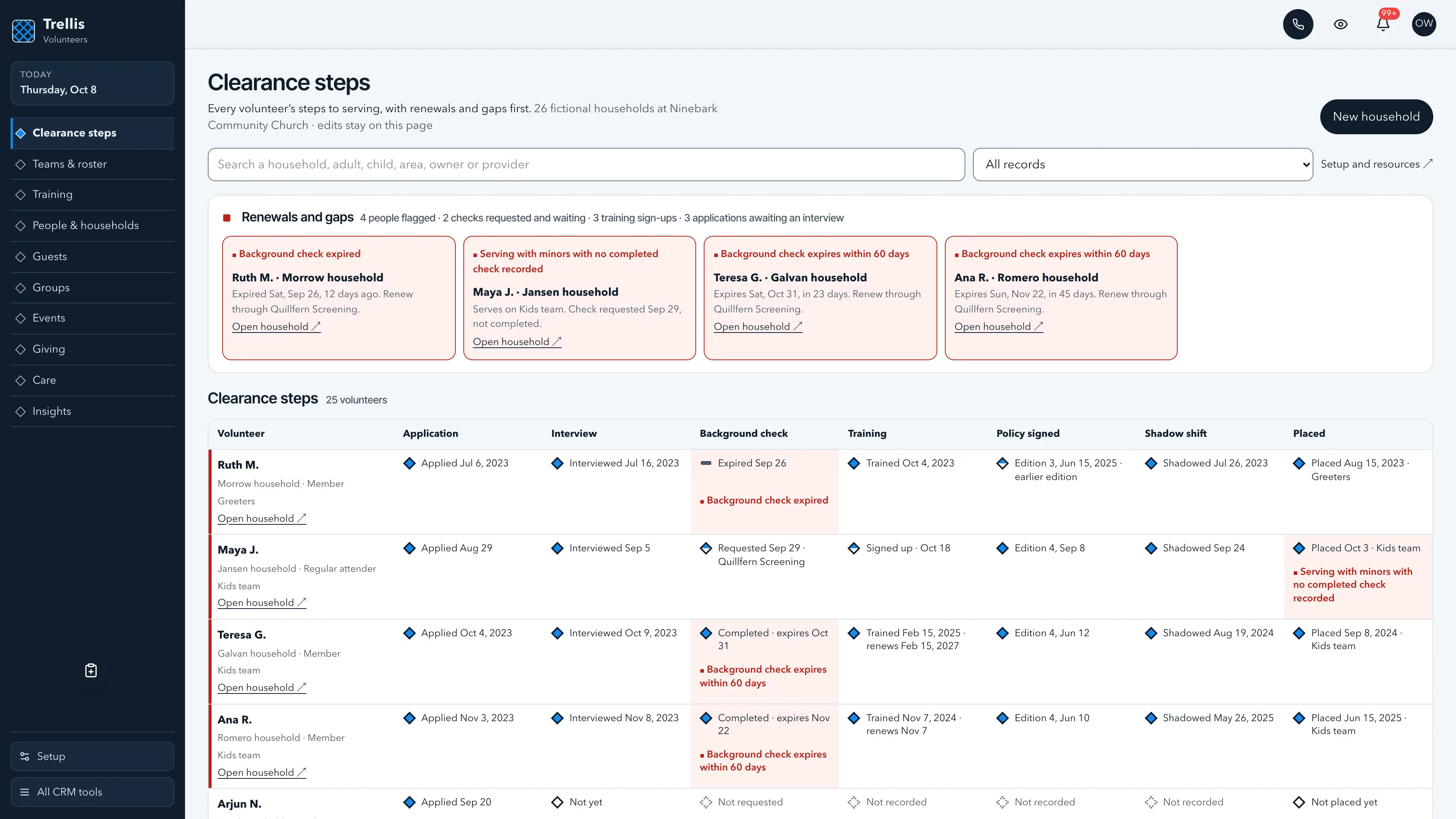
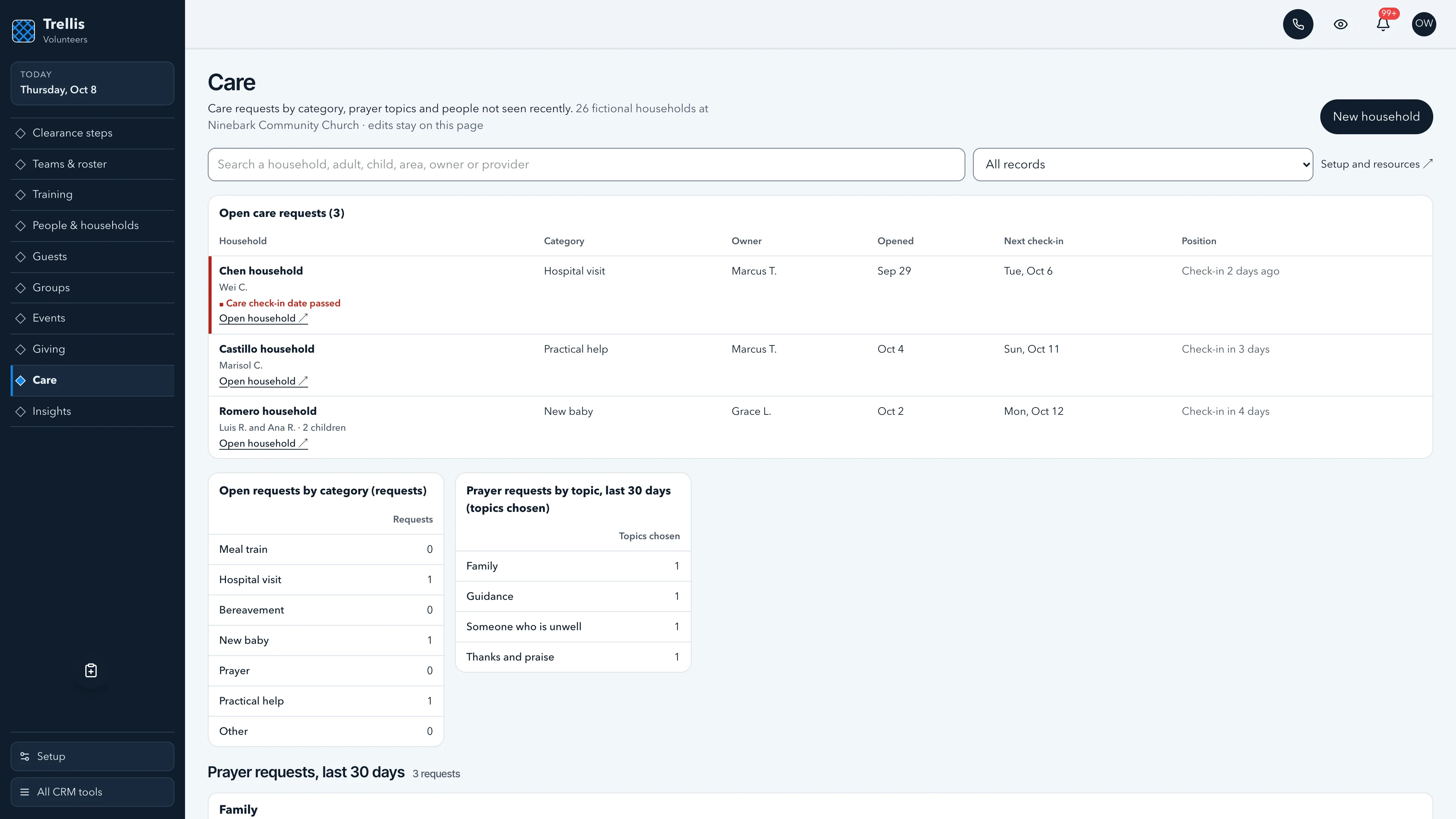
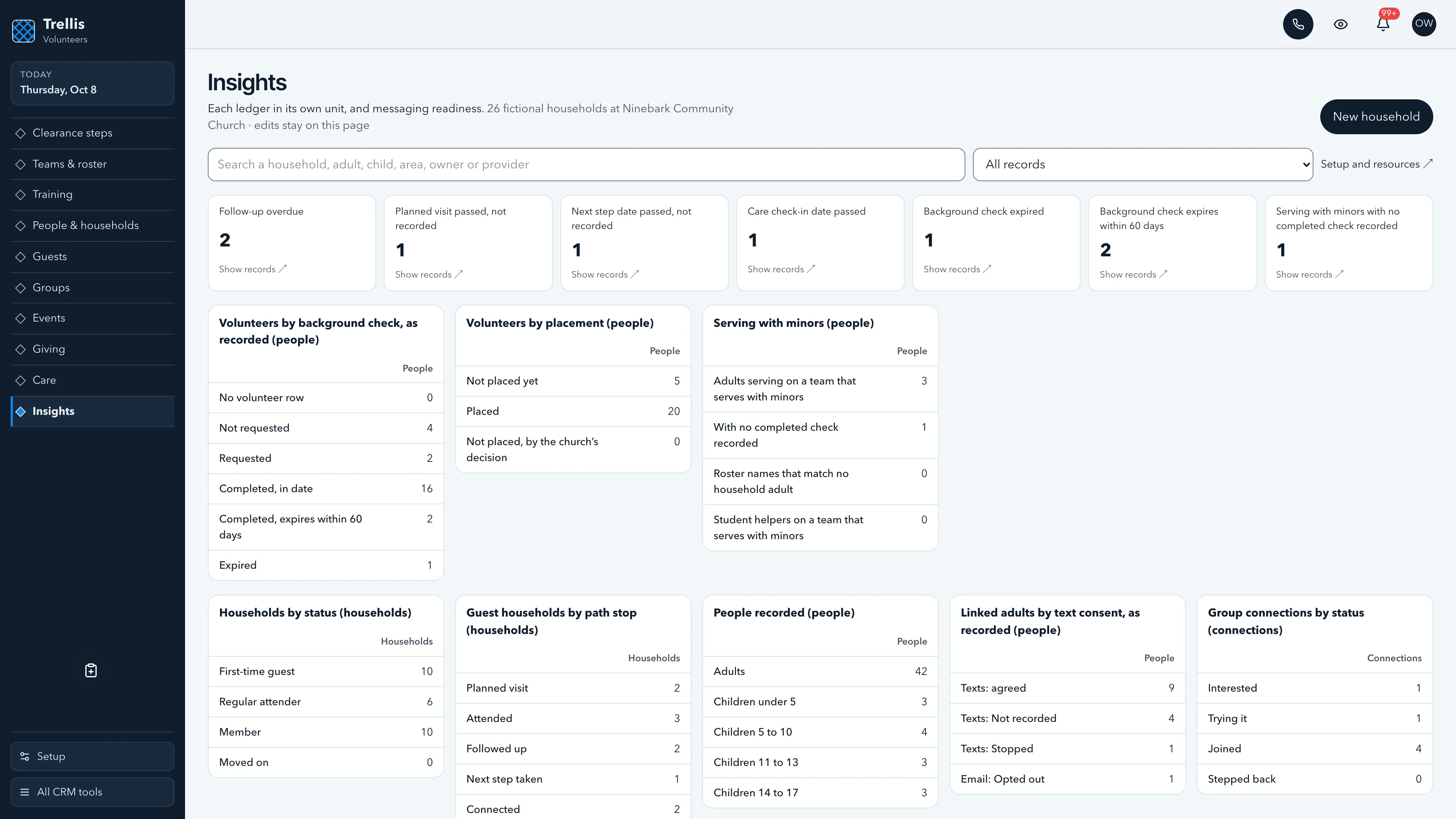
See every volunteer's steps on one matrix.
One row per adult who serves or is applying, with application, interview, background check, training, policy signed, shadow shift and placement as columns, each cell a shape and words: applied Aug 29, requested Sep 29 through your provider, completed and expiring Nov 22, signed up for training Oct 18, placed Oct 3 on the kids team. Above the matrix, Renewals and gaps leads with expired checks, anyone serving on a team that serves with minors with no completed check recorded, placed or not, and checks expiring within 60 days, and says nobody serving with minors is missing a check only when it has read the church lists, a team is marked as serving with minors and every household was read. Student helpers are listed by first name and age band with a parent contact.
Actual interface captures with fictional sample data. Open a screenshot to see it full size.
What’s in the kit
Screens
- Clearance steps operating view with the Renewals and gaps strip
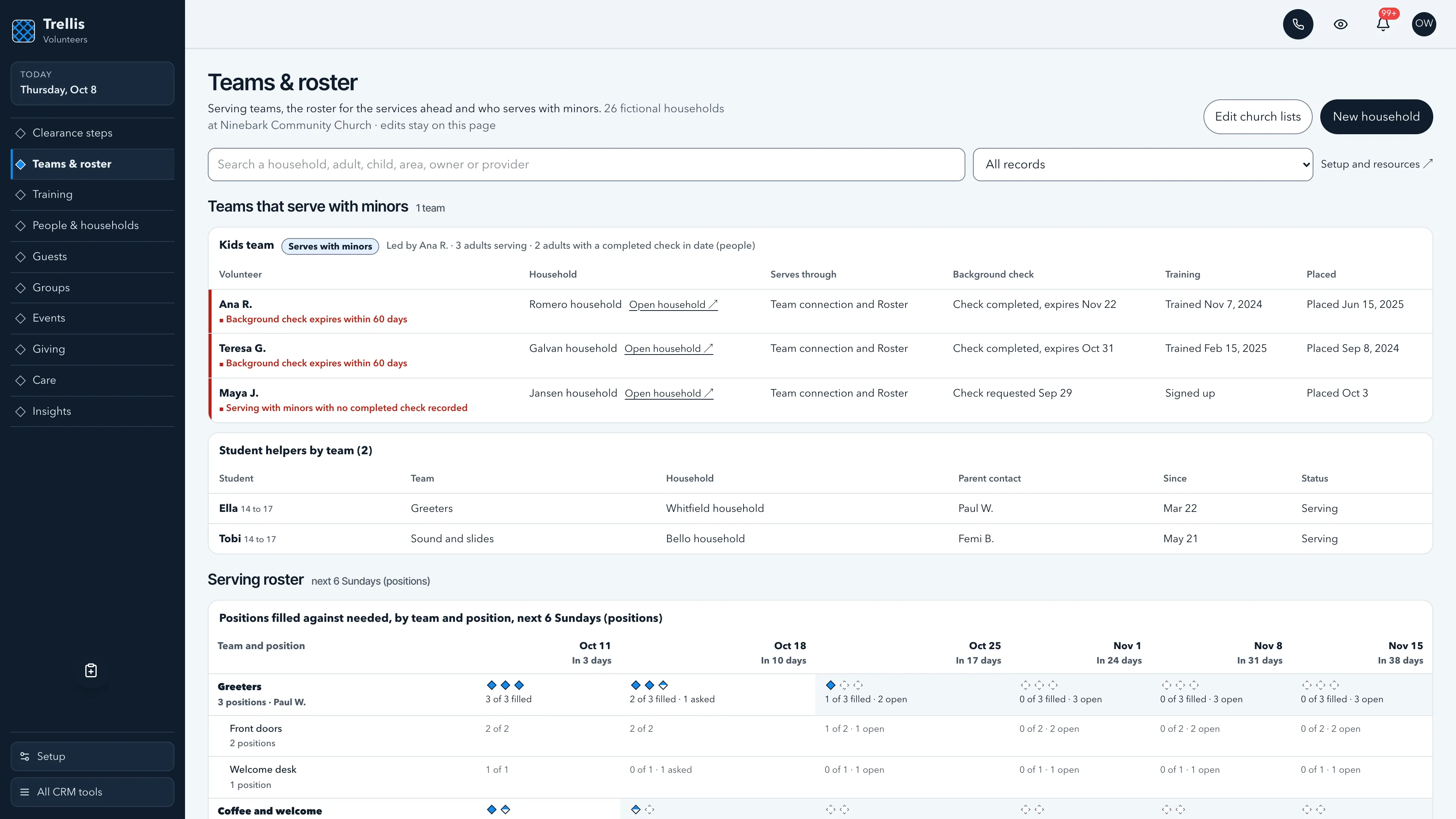
- Teams & roster with every team that serves with minors
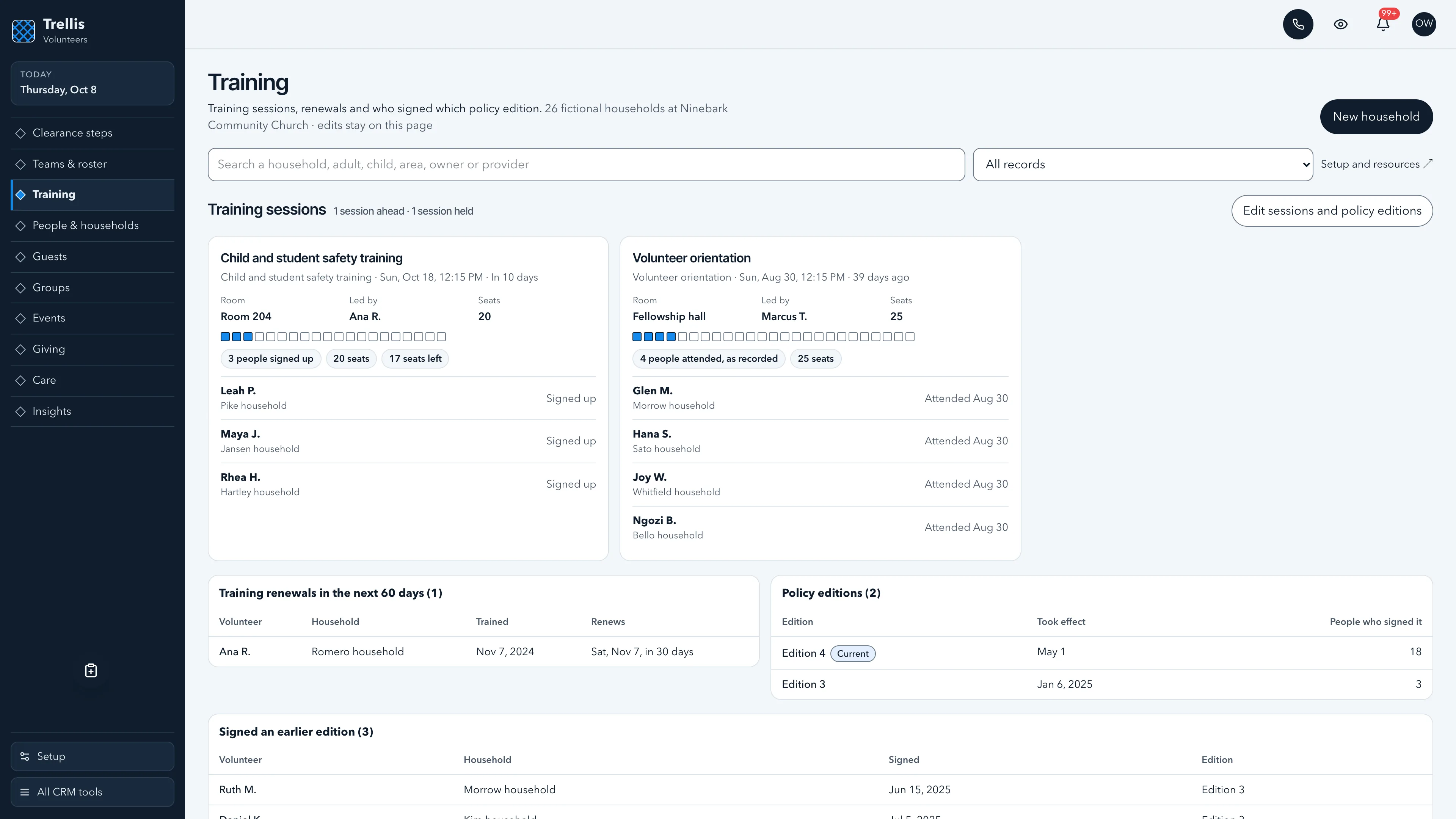
- Training sessions, renewals and policy editions
- Student helpers by first name and age band with a parent contact
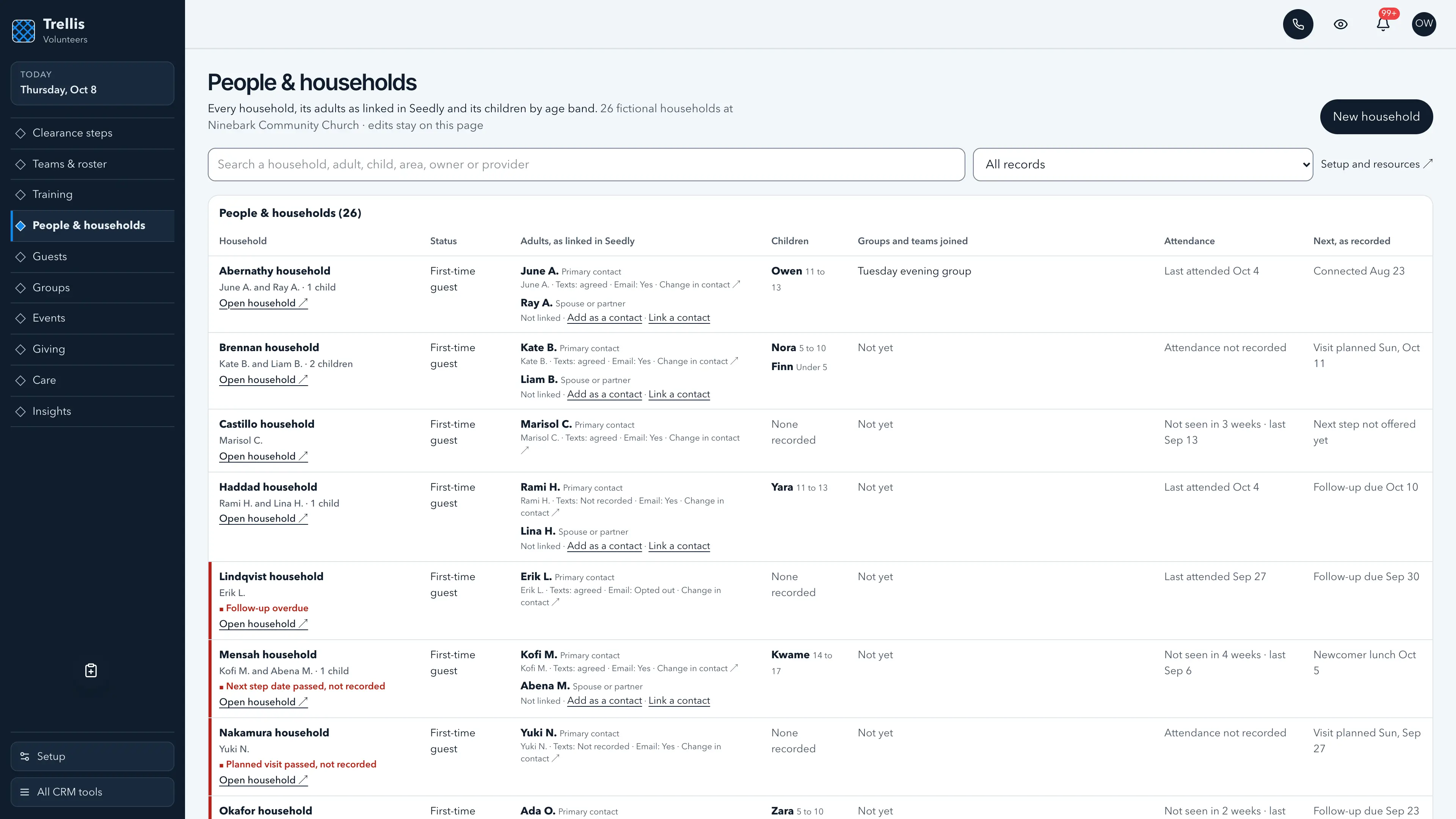
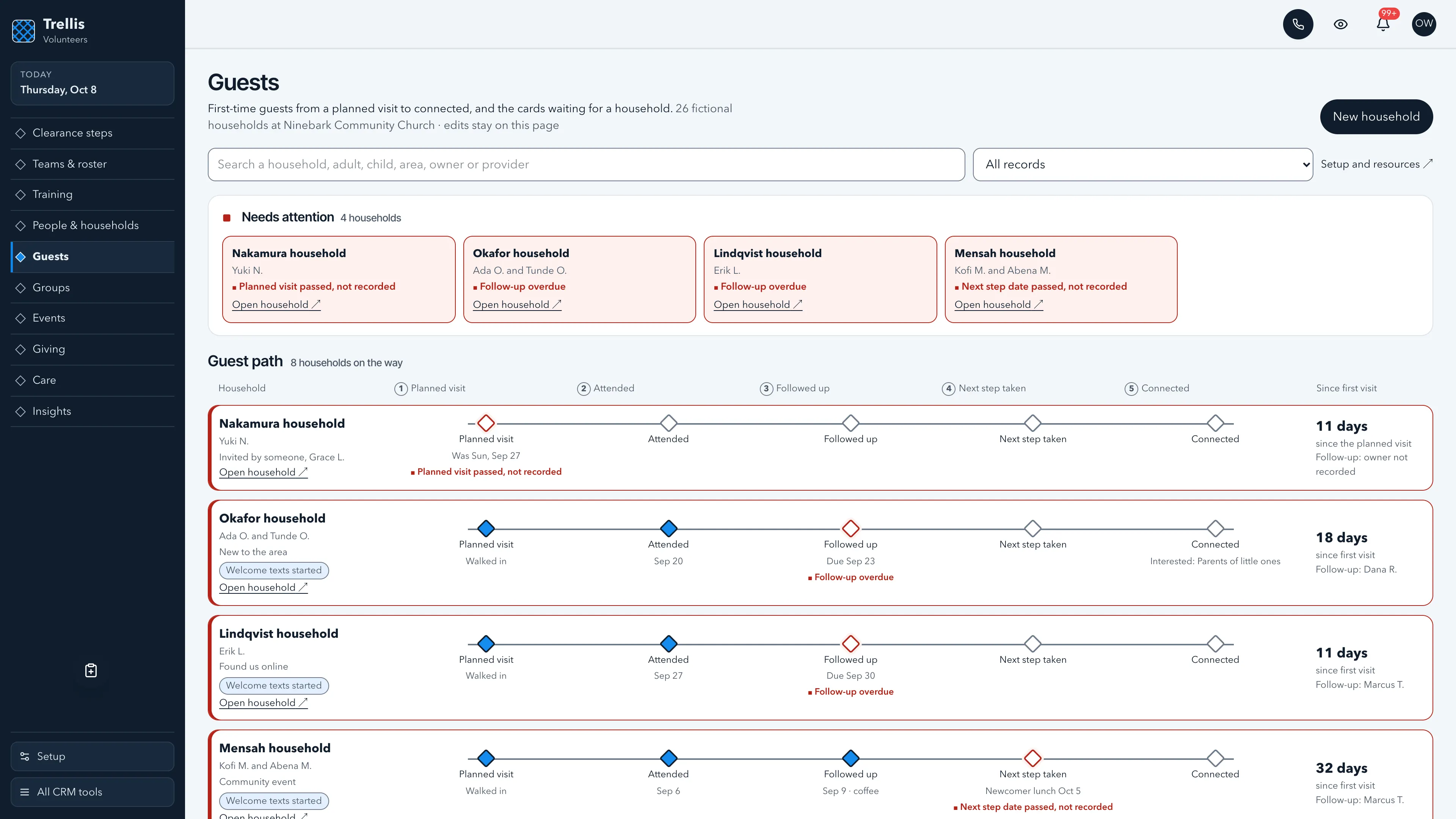
- People & households and the guest path with a card inbox
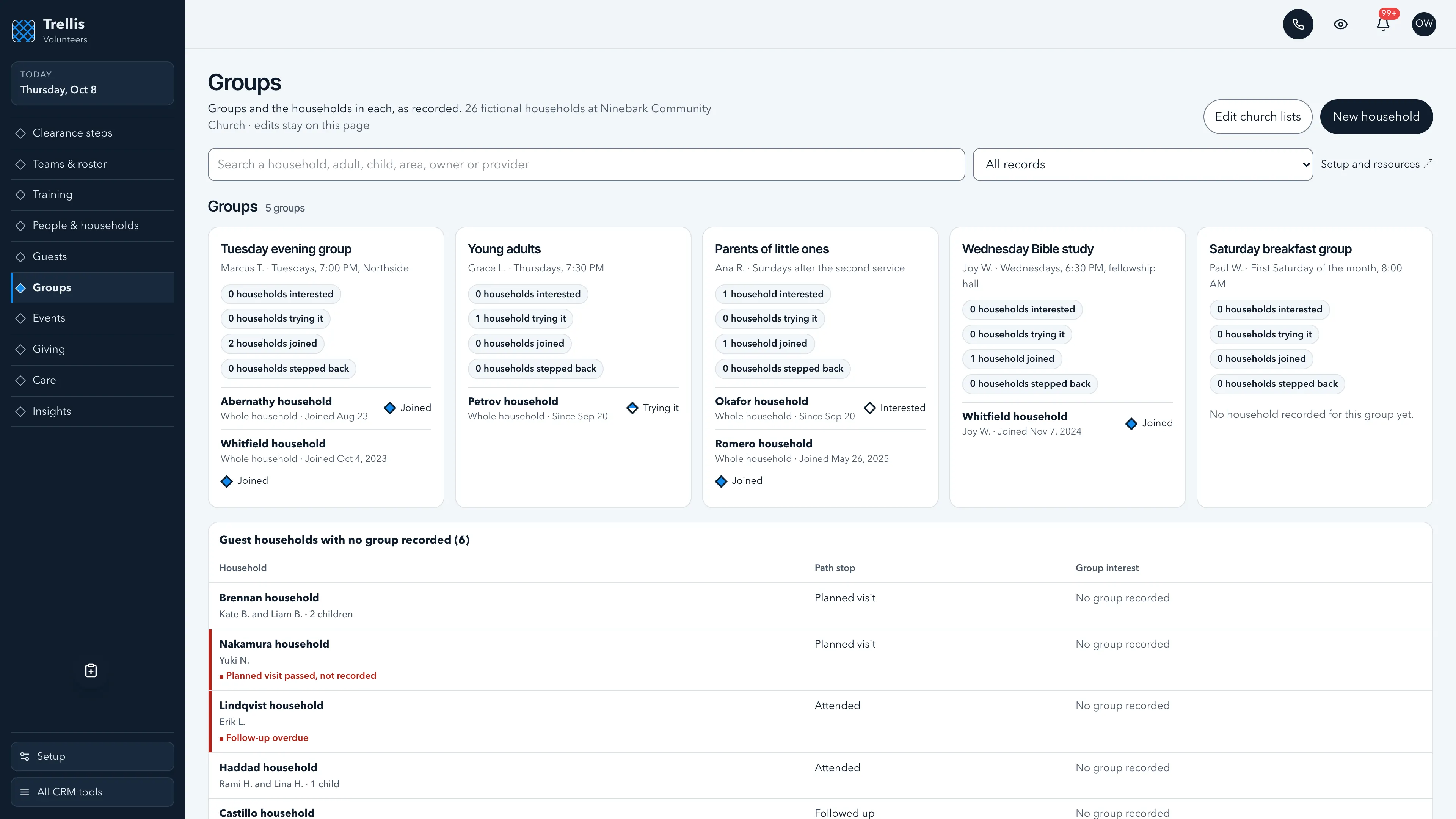
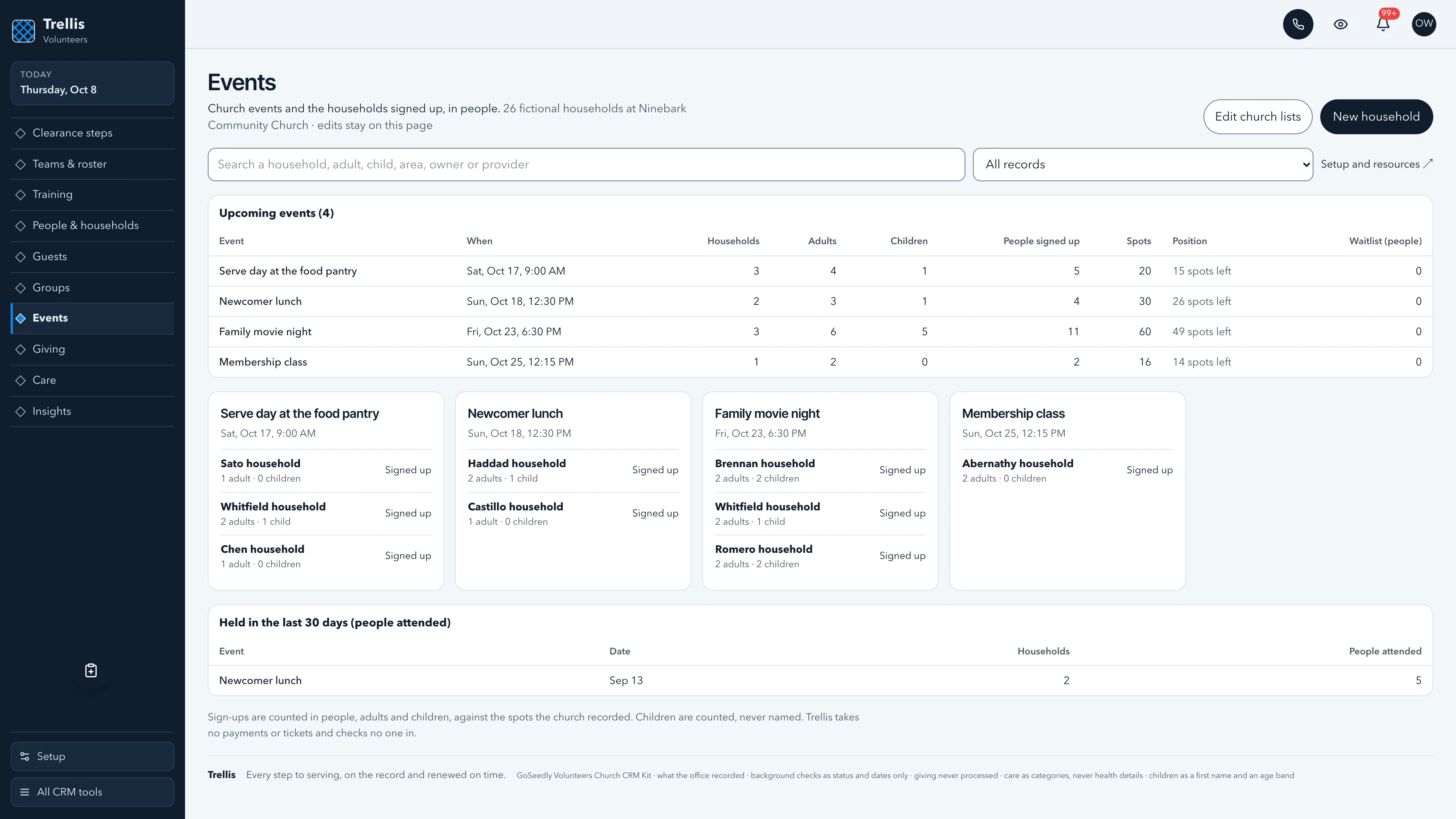
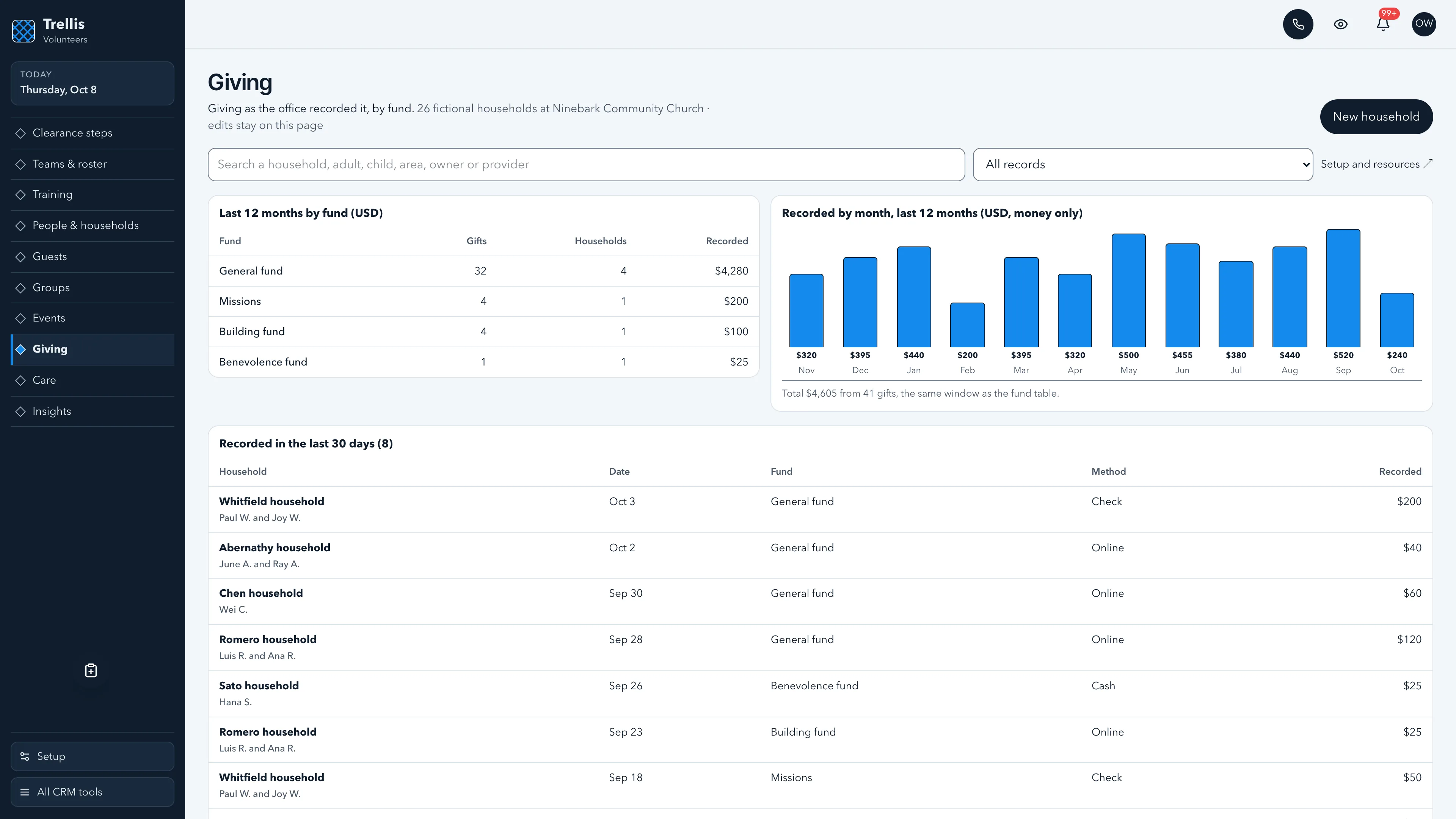
- Groups, events, giving as recorded, care and insights views
- Three message drafts in send mode with every send step off, plus thirteen task drafts
- Six closed-choice native form drafts, including the Volunteer application, and five editable document templates
- Shared church tags, segments, a list, custom values, snippets, a connection card QR code and a pastor calendar
five pipelines
- Guest follow-up · 8 stages
- Serving teams · 7 stages
- Group leaders · 7 stages
- Care requests · 7 stages
- Volunteer onboarding · 8 stages
Optional. Install the ones that match your work, or connect drafts to a pipeline you already use.
16 workflow drafts
- Planned visit welcome
- First visit follow-up
- Next step invitation
- Next step check
- Group leader introduction
- Thirty-day check-in
- Serving team first conversation
- Serving roster confirmation
- Care request owner
- Application received
- Interview scheduling
- Check requested follow-up
- Placement welcome
- Guest welcome from the connection card (texts and emails, every send step off)
- Guest welcome after a recorded first visit (texts and emails, every send step off)
- Re-engagement (a text, a call, an email and a task, every send step off)
Inactive until you review and publish them. Message steps ship switched off.
Forms and documents
- Plan your visit
- Connection card
- Prayer request
- Serving team interest
- Event sign-up
- Volunteer application
- Membership covenant
- Volunteer policy
- Child and student ministry policy acknowledgment
- Volunteer interview guide
- Training sign-in sheet
Editable native forms and document templates. Forms collect information for staff review.
Sample workspace
Explore Ninebark Community Church, a fictional church of 26 households with 42 adults and 13 children recorded as a first name and an age band: 25 volunteers with their steps, three background checks expired or expiring within 60 days, one adult serving on the kids team with no completed check recorded, two student helpers, two training sessions, two policy editions, nine households with an alert, first-time guests, groups, a two-service roster, events, care requests, 41 recorded gifts and usher headcounts. Sample edits stay in memory and reset on navigation or reload.
No sample customers are added to your CRM.
Setup and source
- Guided setup and compatibility report
- Private rollback receipt
- AI-agent guide for customized installations
- Original editable source, configuration, and tests
How setup works
Full installation guideCheck your Seedly
Extract the kit and run the guided setup. It checks your installation and flags customized files before it changes anything.
Connect the helper
Deploy the included helper from your backend source, then build your web app and choose any starter pipelines and drafts.
Make it yours
Set business name, descriptor, default pipeline name and message mode. Then sign in and check the workflows and permissions your team uses.
Technical details and compatibility
Seedly CRM 5.8.4 · extension API 1. Node.js 20 or newer. The installer checks supported integration-file versions and does not deploy your web app or backend. The included original backend helpers are required for connected household creation and edits, volunteer rows, the church lists, the training record, linked contacts and setup. They preserve native account permissions, unrelated custom fields and row history, keep households, people, seats, positions and money apart, refuse background check results, report numbers, offences and court words (in names too), credit and driving records, children's ages and names lists, allergy and custody notes, health details, access codes, logins, card and bank numbers and Social Security numbers as a guard against accidental entry rather than a guarantee, refuse dates still ahead for things that already happened, and check revisions before saving. A paged household query reads the household pipeline past Seedly's 1,000-opportunity board read, and the card inbox, prayer topics and consent counts read within a set budget per read and say when they stopped short. To update from an earlier release, remove the earlier source and install this one in your working tree with no deploy or build in between, then deploy the backend, then build and deploy the web app; an earlier page that is still open keeps working against the newer helpers in between, and QUICKSTART.md says what to do if removal refuses. Pipelines, drafts, forms and documents are optional.
One contact-linked household record holds the household's status, the guest path, an office note, its adults linked to Seedly contacts, its children as a first name and an age band only, the groups and serving teams it joined, recorded attendance, event sign-ups, gifts as recorded by fund, care requests as category labels, a checklist, each adult's volunteer row (application, interview, background check status with its requested, completed and expiry dates and the provider's name, training and renewal, policy signed and its edition, shadow shift and placement) and any student helpers by first name, age band, team and parent contact. The church's services, funds, teams (each marked if it serves with minors), groups, events, roster and usher headcounts live in the account's own church lists, and training sessions and policy editions in their own record. The shared church lists fit one to three weekly services; a church with four or more should keep its roster and headcounts elsewhere for now.
Trellis records what the office recorded. A background check is only a status and dates: Trellis never runs or orders one, has no connection to any screening company, keeps no result, report or case number, offence, credit or driving record, Social Security or license number, address or date of birth, and refuses them in every note. Completed means your provider's check finished on that date; placing someone on a team is your church's own decision, and Trellis never says anyone is cleared, safe or compliant. Saving a household keeps the church tags on its linked contacts and moves the guest follow-up opportunity forward a stage, never back; volunteer steps write nothing else. Trellis reads every open household of the pipeline page by page, so none drops off past the 1,000 opportunities Seedly's board shows, and every date is read in your church's own time zone. Counts and totals read every household while the search narrows only the lists, red marks only the named alerts, and each view says when it is still reading instead of showing an empty list. The Volunteer onboarding board is optional and never synced: its Interview scheduling, Check requested follow-up and Placement welcome drafts run only when someone in your office moves an opportunity into that stage in Seedly. The three message drafts hold real texts and emails with every send step switched off, every text behind a check that the contact agreed to texts and every email behind one that they did not opt out, every text ending with the opt-out line, each draft added with a 10:00 to 19:30 church-time send window, and a paused check ending the run rather than sending; you add them only after ticking that you record consent, you can add them before your A2P campaign is approved, and nothing sends until your office reads each step and turns it on. Trellis has no child check-in and refuses children's exact ages, birthdays, names lists (also after youth words, as in “Youth: Leo, Ava, Sam”), allergy and custody notes. Care requests are category labels and health details are refused. Giving is only what the office typed in: Trellis never processes, imports or receipts gifts and makes no tax claim. Access codes, Wi-Fi and portal logins, card, bank and routing numbers are refused in recorded text, while church text such as John 3:16, Room 204 and Background check requested is kept. That is a guard against accidental entry, not a guarantee, and the shapes it cannot tell from ordinary text are listed in the README. The public form drafts hold only names, email, phone and fixed choices, every name answer refuses check results and offences, and the Volunteer application has no identity field. Install one church kit per Seedly installation. A matching Seedly church website template is available separately.
Five optional pipeline templates and 16 inactive workflow drafts. 26 fictional in-memory households.
Calling, messaging, signing, payments, and external integrations depend on your Seedly installation, account permissions, plan, and configured providers. Screenshots use sample data and reference imagery. Hosting, installation, and ongoing maintenance are your responsibility.
Get the Volunteers Church CRM Kit
Checking access…

DevLaunch All Access
Every kit and every template.
- All 220 CRM kits for Seedly CRM
- All 190 website templates for Seedly Sites
- Every class, course, and product we release, added as it ships
- Private calls with Aaron
Already a member? Open your downloads.
Questions
How do I receive the kit?
Purchase securely through Whop. Your original source ZIP and installation documentation are delivered manually to the email used at checkout. This is a one-time purchase of this kit; Seedly software, hosting, and installation services are separate.
Does this include Seedly CRM?
You obtain and configure Seedly separately. The kit adds original frontend screens, a shared theme, starter definitions, and integration instructions. It does not include Seedly’s codebase, license, hosting, or a separate CRM database.
Is this one connected workspace?
Trellis keeps its dark lattice rail with the ten views beside the kit views and the native CRM tools in the same signed-in account. Contacts, Calendar, Estimates, Documents, and other full modules retain the functionality supplied by your own Seedly installation. Existing authored content and provider screens retain their own layouts.
Can I use it with existing customizations?
Yes, with a compatibility review. The installer checks the supported integration files. Changed integration files need a reviewed merge; the included AI-agent guide explains how to preserve custom extensions, permissions, providers, and routes.
Do I have to import all the starter content?
No. Choose individual pipelines and workflow drafts, use a compatible existing pipeline, or install none. Workflows remain inactive until reviewed and published. The task drafts use native triggers, internal tasks, optional notes and timed waits. The three message drafts hold text and email steps that ship switched off. Each step sends only after your office turns it on, and texts go only to people with recorded consent. A wait does not verify task completion or recheck the current stage.
Can I remove the examples and starter content?
Sample records stay in memory and never create customers in your CRM. Leave sample mode to return to your account. Starter setup lets you review removal of unused kit additions; server checks retain edited or published workflows and pipelines with live work or references. Removing the frontend does not delete account records.
Can different subaccounts use different kits?
The current design and branding apply to the whole web installation. Subaccounts still separate data and access. Use a separate web installation for another full-interface kit; running different kit designs by subaccount in one installation requires additional customization.
More hospitality, events & creative kits
Browse all 220 kits