Every shoot day crewed. Every round accounted for.
A shoot-day call board over a deliverable cut tracker. Callsheet puts the dates that cannot move on top, with the crew each one still needs, and the versions and revision rounds that keep moving underneath.
The days that cannot move, and the cuts that keep moving.
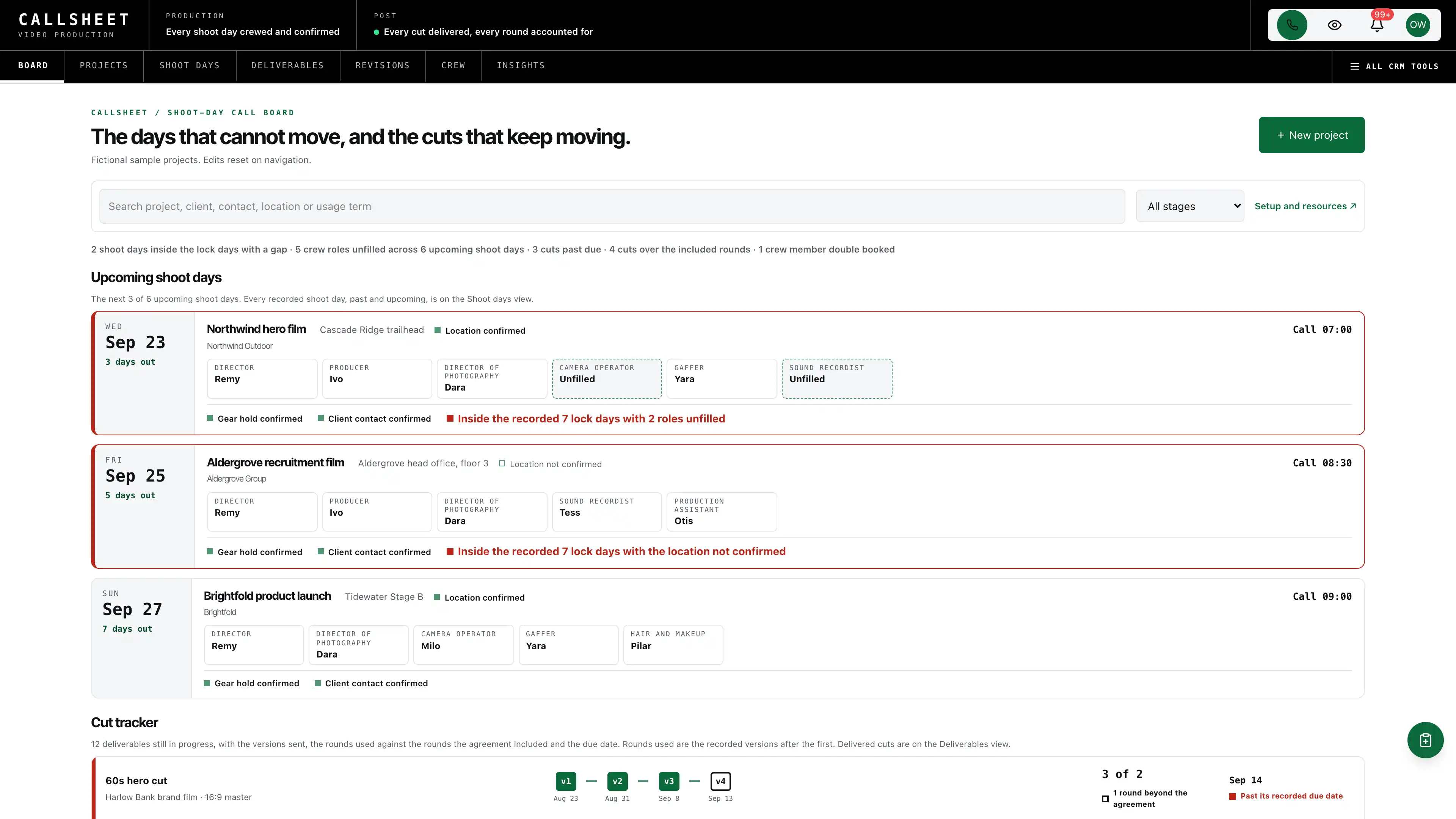
Upcoming shoot days as wide cards in date order, each with the project and client labels, the general call time, the location with its confirmed flag, a crew grid of the roles that day needs showing the assigned person or "Unfilled", the gear hold and client contact flags and the days until the shoot. Beneath them the cut tracker, one row per deliverable in progress with its version chain, rounds used against rounds included, state and due date.
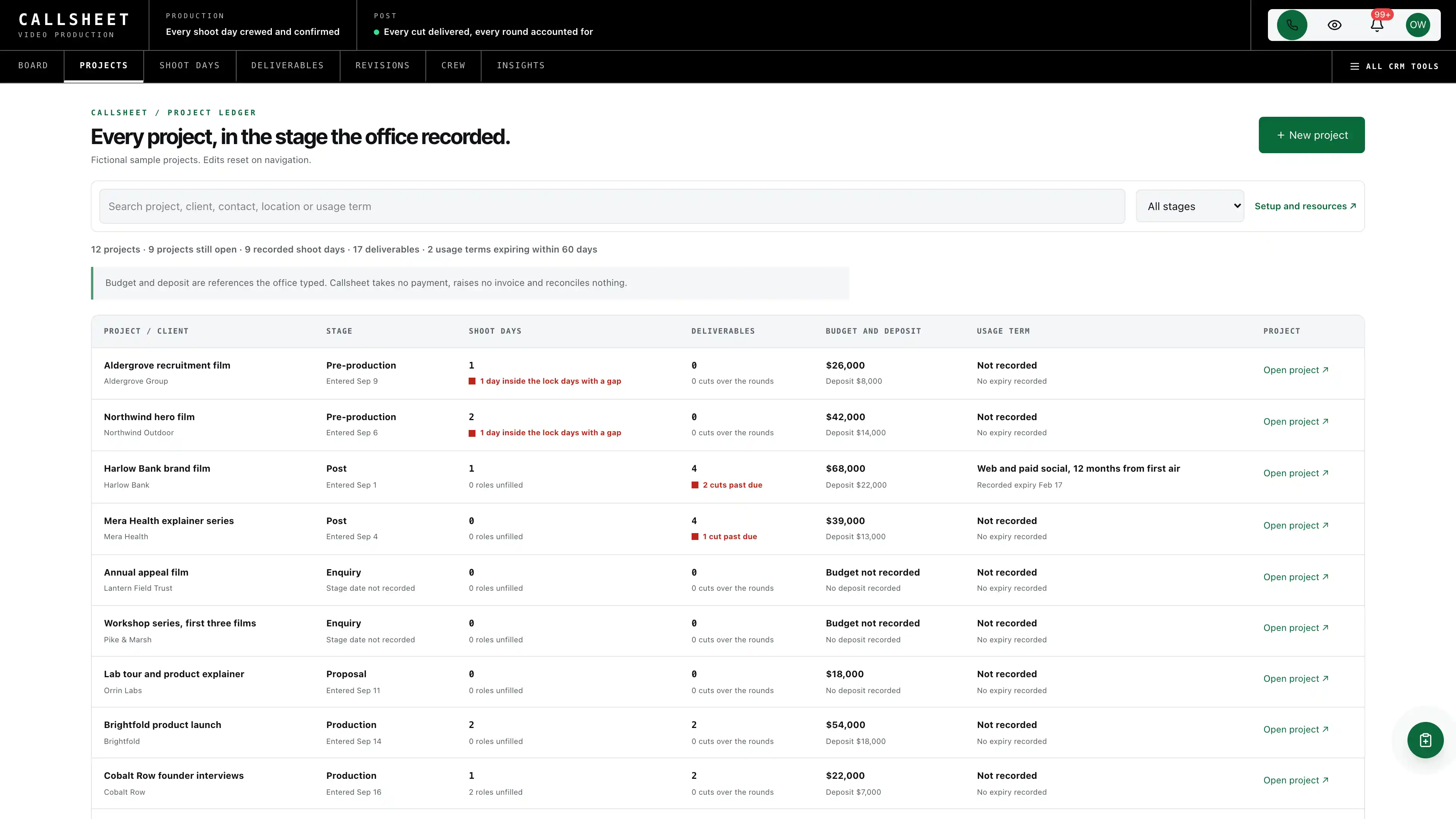
Client and project labels, the recorded stage with the date it was entered, shoot day and deliverable counts, the budget and deposit as recorded references, and the usage term with its expiry. Projects carrying open urgent work lead the ledger.
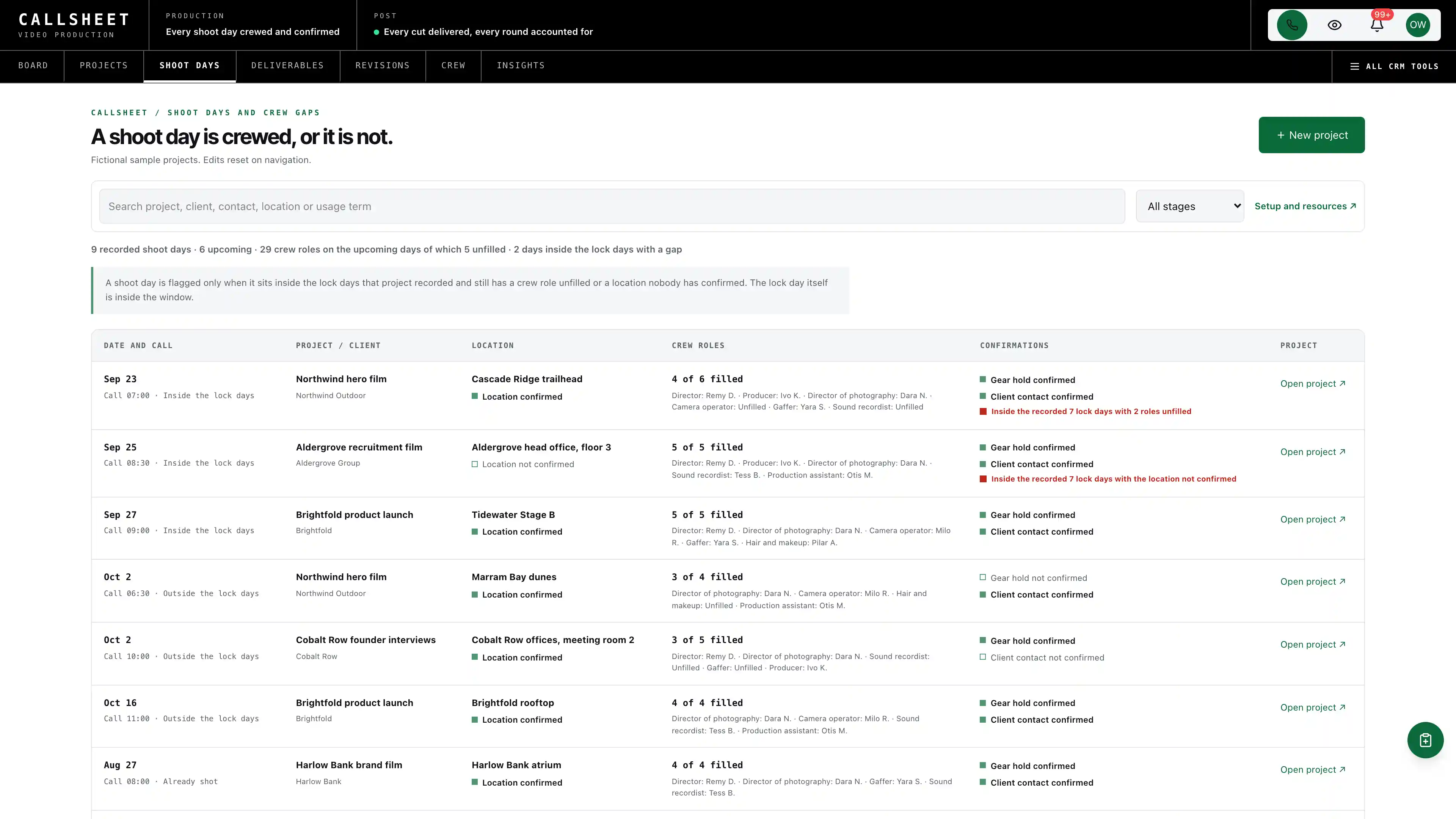
Every recorded shoot day in date order with its call time, whether it sits inside the recorded lock days, the location and its confirmed flag, how many of its roles are filled and who fills them, and the gear hold and client contact flags. A crew member recorded on two shoot days on one date is listed separately.
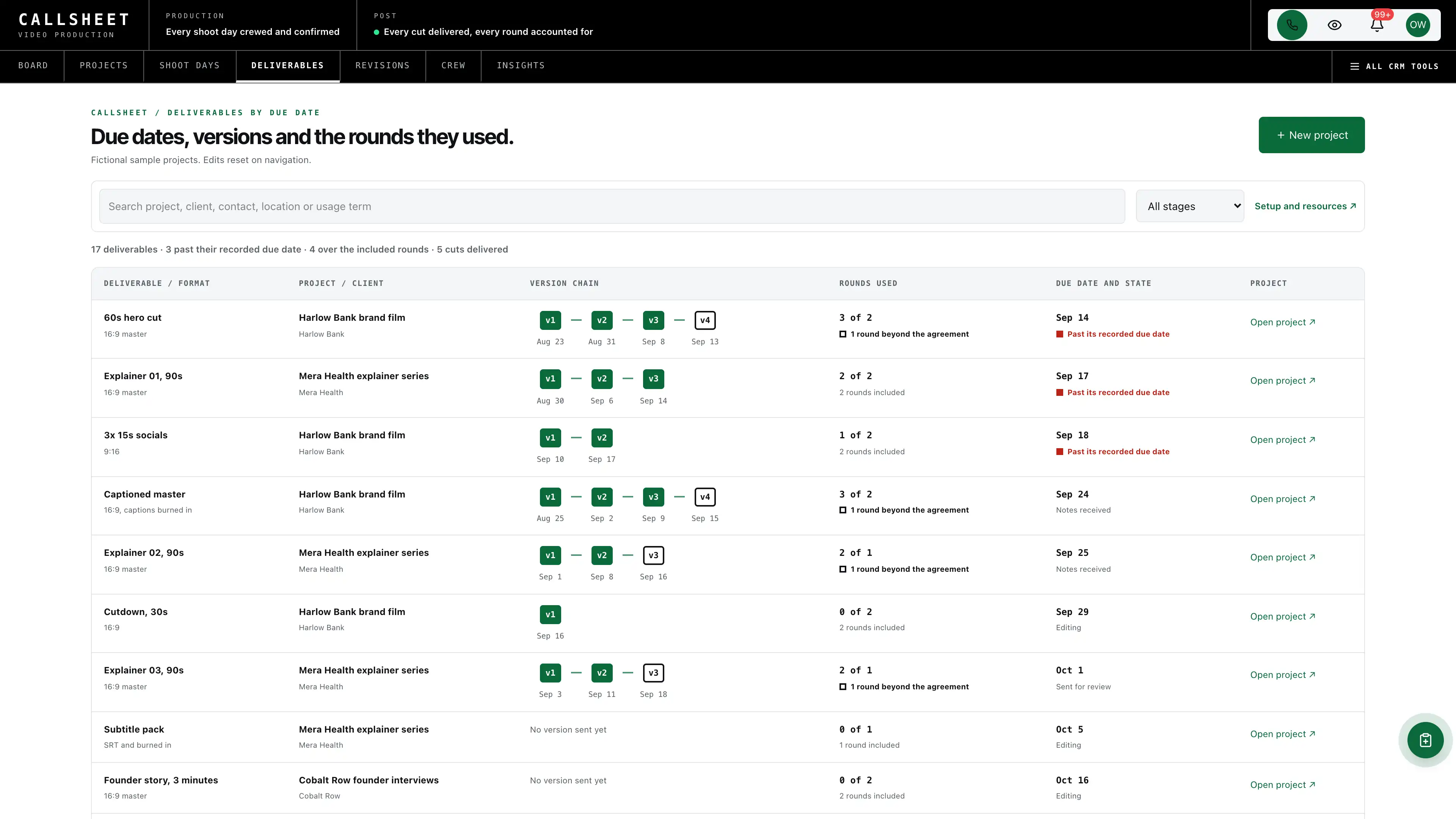
Every deliverable ordered by due date with its format label, the version chain as dated nodes, the rounds used against the rounds the agreement included and the recorded state. A cut past its due date says so in words, in red, with its own marker.
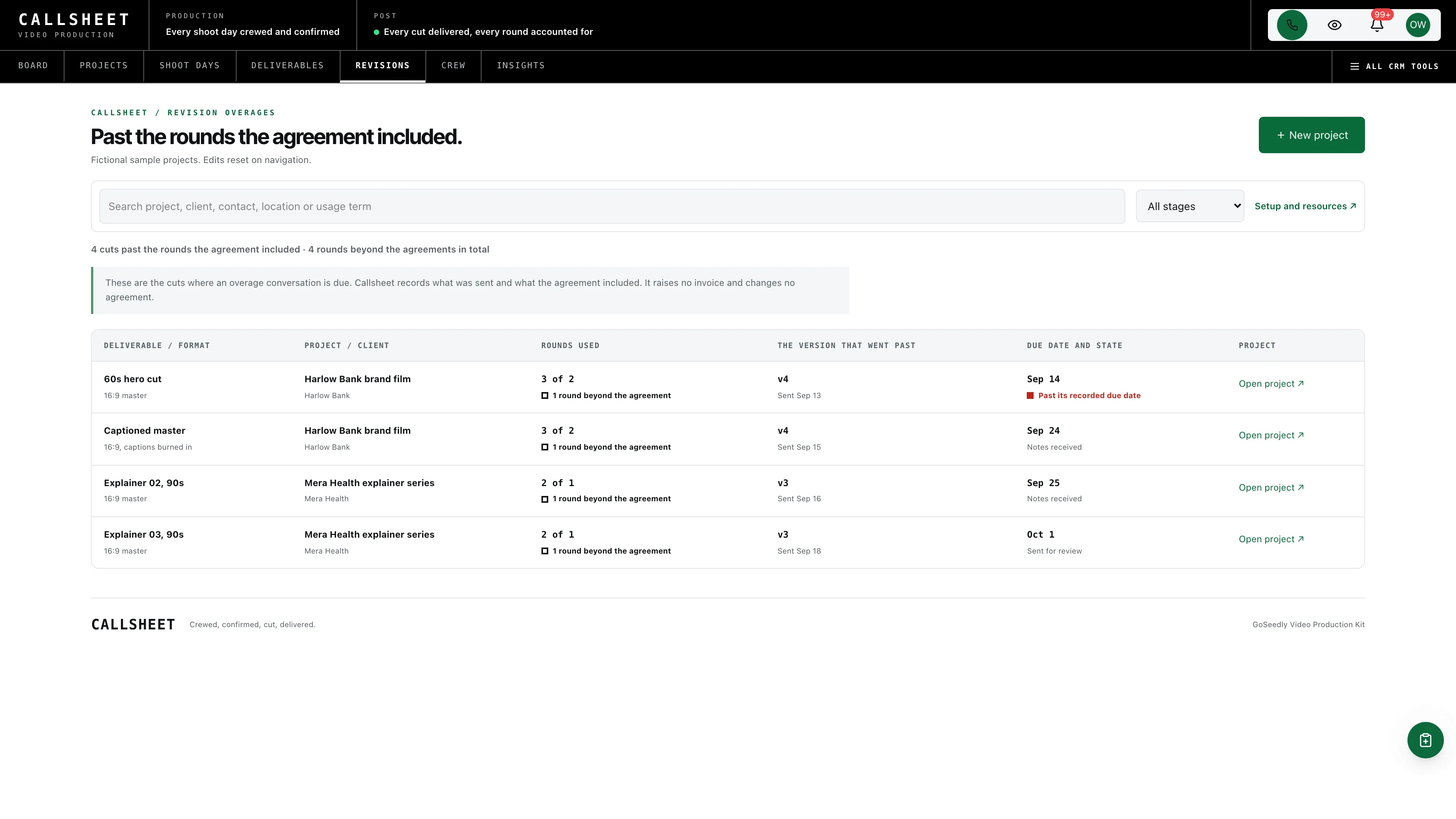
Only the cuts where an overage conversation is due, with the rounds used against the rounds included, the version that went past and the recorded due date and state. Callsheet records what was sent and what was agreed; it raises no invoice.
The people and the rental houses you actually call.
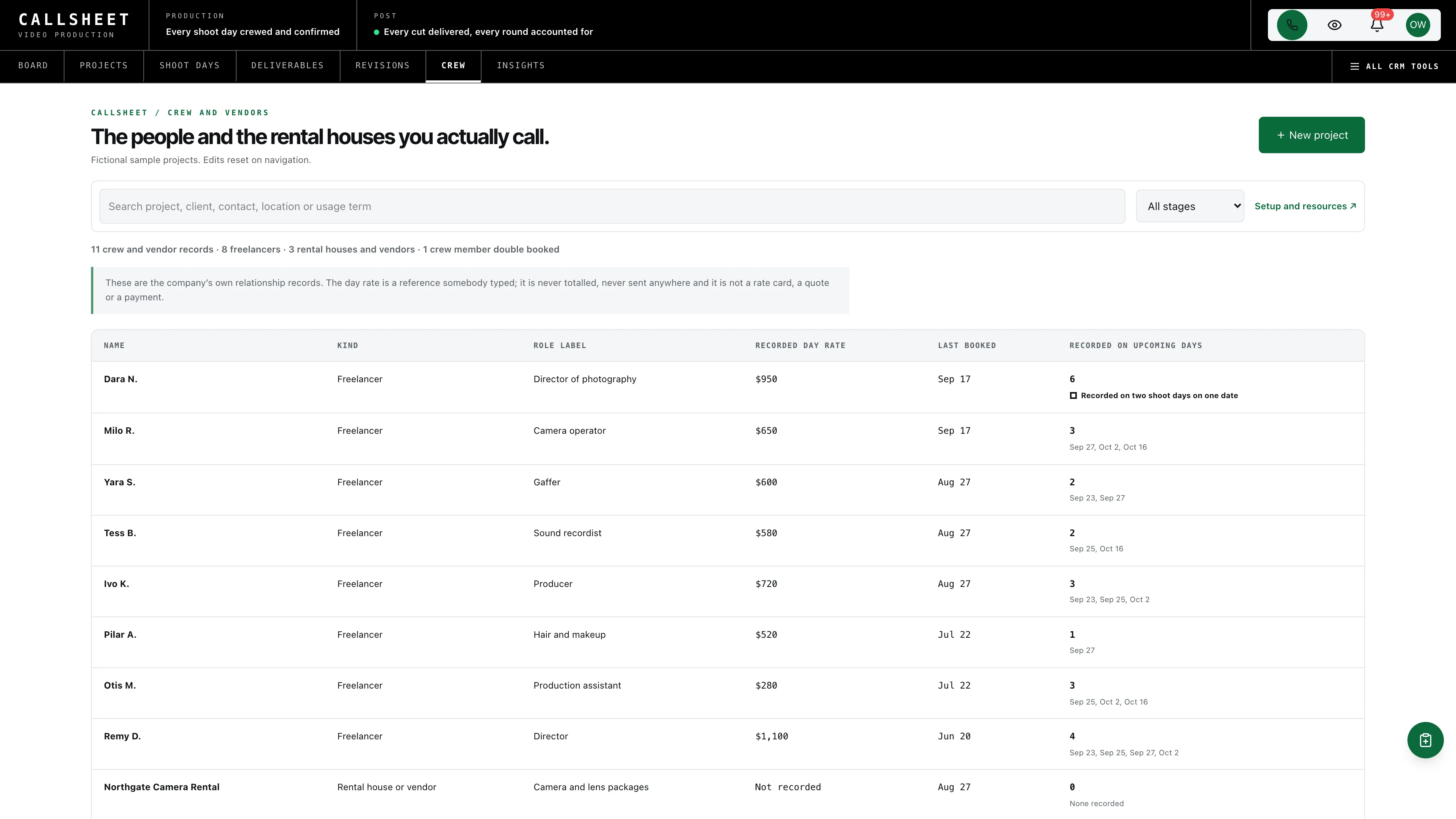
Freelancers and rental houses as relationship records with a role label, a recorded day rate, a last booked date and how many upcoming shoot days they are recorded on. The records themselves are edited here and archived rather than deleted.
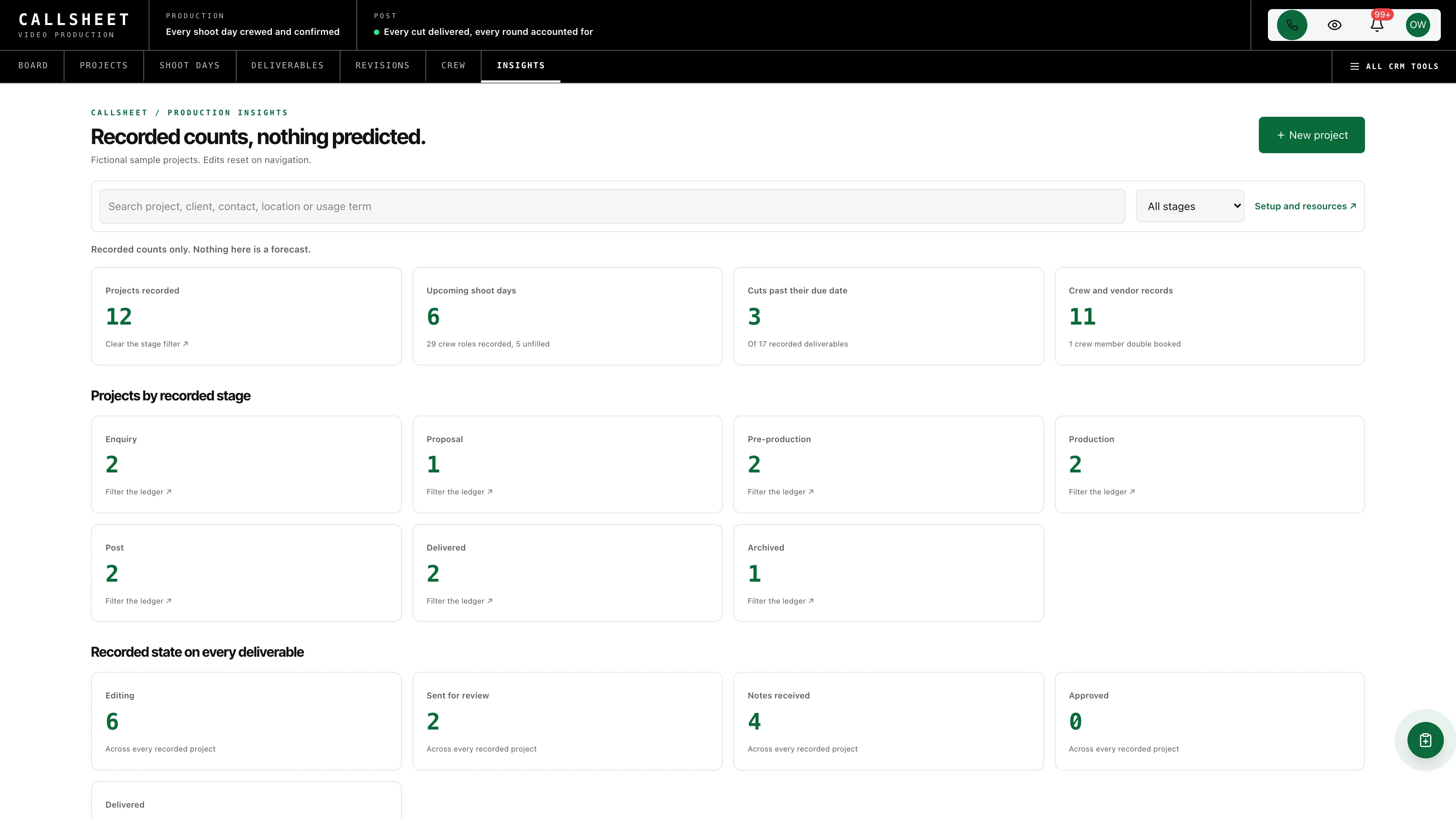
Projects recorded, upcoming shoot days, cuts past their due date and crew records, then projects by recorded stage and the recorded state on every deliverable, each one a filter over the ledgers below it.
YOUR PROCESS, YOUR STARTING POINT
Useful structure. Only what you choose.
4 pipelines and 9 workflow drafts. Add the parts that match your work, with a separate sample view for exploring the interface.
01 / FOUR PIPELINES
Choose your starting structure.
Use a ready-made stage sequence or connect drafts to a suitable existing pipeline.
Video projects · 7 stages
Content retainers · 7 stages
Event coverage · 7 stages
Brand accounts · 8 stages
02 / NINE WORKFLOW DRAFTS
Give the next step a shape.
New enquiry
Proposal follow-up
Shoot day crew gap
Location confirmation
Gear hold
Cut sent for review
Review notes chase
Revision overage conversation
Usage term expiry
Native trigger, task, wait, and note nodes provide editable examples. Every draft stays inactive until you review and publish it.
03 / SAMPLE WORKSPACE
Explore before adding records.
Explore 12 fictional projects across all seven recorded stages: 6 upcoming shoot days carrying 29 crew roles of which 5 are unfilled, 2 of those days inside the recorded lock days with a gap, 1 crew member booked on two shoot days on one date, 17 deliverables of which 3 are past due and 4 are over their included rounds, 11 crew and vendor records and 2 usage terms expiring within 60 days. Sample edits stay in memory and reset on navigation or reload.
No sample customers are inserted into your CRM.
Starter setup checks selected kit additions before removal and preserves edited records and live work.
MORE OF THE WORKING DAY
From the first inquiry to the final handoff.
Editable native forms and document templates give your team a practical starting point.
01 / INTAKE & FOLLOW-UP
Three ready-to-edit forms.
Project enquiry
Shoot day details
Review notes request
Choose forms individually in Setup & resources, then customize and publish them in the native form builder.
02 / WORKING DOCUMENTS
Three reusable templates.
Shoot day call sheet
Deliverables and revision summary
Usage term reminder letter
Open each template in Documents and complete it for the actual job or visit.
03 / THE NEXT STEP
Checklists alongside the work.
Record progress and notes in the kit’s operating views. Keep earlier rows by archiving them, and retain the context for the next person.
Forms collect information for staff review. They do not automatically change the kit’s custom records. Repeating setup preserves existing resource edits.
THE KIT, UNPACKED
Your workspace. Your starting point. Your code to edit.
One contact-linked opportunity is one video project. It holds the client and project labels, the recorded stage with the date it was entered, budget and deposit as recorded references, the recorded lock days, a release-forms-on-file flag, a usage term with its expiry, an editable checklist, and stable child rows: shoot days with a call time, location label and location, gear hold and contact confirmed flags; crew roles with the role label the company uses and a crew reference or an empty one meaning unfilled; deliverables with a format label, due date, rounds included and state; and versions with their position in the chain and the date each was sent. Crew and vendors live in the kit’s own store behind a server-owned revision, because a freelancer exists before any project books them.
Shoot-day call board with crew grids and confirmation flags
Deliverable cut tracker with version chains and rounds used
Projects operating view
Shoot days operating view with crew gaps and double bookings
Deliverables and Revisions operating views
Crew and vendors operating view with its own record editor
Insights operating view
Three native form drafts and three editable document templates
Editable per-project checklists and preserved row history
Four optional pipeline templates and nine inactive workflow drafts
12 fictional in-memory projects with 6 shoot days and 17 deliverables
Guided setup, compatibility report, and private rollback receipt
AI-agent documentation for customized installations
Original editable source, configuration, and tests
Run the guided setup from the extracted kit. Supported integrations can be installed directly; customized integration files get a reviewed merge.
02
Connect the required helper.
Deploy the included helper from your authoritative backend source before connected edits. Build your web app, then choose any optional pipelines and drafts you need.
03
Set up your own team.
Edit company name, descriptor and default pipeline name. Sign in with your account and verify the workflows and permissions your team uses.
Compatibility and operational details
Seedly CRM 5.8.4 · extension API 1. Node.js 20 or newer. The installer checks supported integration-file versions and does not deploy your web app or backend. The included original backend helpers are required for connected project creation, edits, the crew and vendor store and resource setup. They preserve native account permissions, unrelated custom fields and row history, enforce the production rules and the storage guard on the server, and check revisions before saving. Deploy them from the authoritative backend source. Pipelines and workflow drafts are optional.
Callsheet stores no files, no footage, no link with a user name and password inside it, no talent identity document and no payment detail. Release forms are a recorded on-file yes or no flag and nothing more, and every free-text field refuses credential links, government identifiers and card-like digit runs in the browser and again on the server while still accepting a plain review link, a timecode, a phone number and a purchase order reference. That is a guard against accidental entry, not a guarantee. A shoot day is flagged only when it sits inside the lock days that project recorded and still has a role unfilled or a location nobody has confirmed, and the lock day itself is inside the window. A cut is late strictly after its due date, and rounds used are the recorded versions after the first. There is no file storage, review player or version hosting, no editing software or asset manager integration, no crew payroll or booking marketplace, no permit, insurance or release management, no music licensing, no scheduling engine, no automated messaging and no payments or invoicing.
Calling, messaging, signing, payments, and external integrations depend on your Seedly installation, account permissions, plan, and configured providers. Screenshots use sample data and reference imagery. Hosting, installation, and ongoing maintenance are your responsibility.
Checking access…
DEVLAUNCH ALL ACCESS
Every kit. And everything else.
DevLaunch All Access includes every GoSeedly CRM kit, all 195 available today, along with every class, course, and product we release, and private calls with Aaron.
All 195 CRM kits
Every published kit as original editable source, with optional pipelines, workflow drafts, and guided installers. Browse the kits
Every class, course, and product
The full DevLaunch library and software collection, plus each eligible release during your access year, added to your portal as it ships.
Private calls with Aaron
Bring the idea, the offer, or the bottleneck, and leave with a plan you can follow.
DevLaunch All Access
Want more than one kit? All Access covers the whole CRM kit library and the rest of what we make. See everything it includes on the All Access page.
For your own compatible Seedly CRM. Seedly software, hosting and installation services are separate. Each full-interface kit uses its own web installation.
BEFORE YOU MAKE IT YOURS
Good questions. Clear answers.
How do I receive the kit?+
Purchase securely through Whop. Your original source ZIP and installation documentation are delivered manually to the email used at checkout. This is a one-time purchase of this kit; Seedly software, hosting, and installation services are separate.
Does this include Seedly CRM?+
You obtain and configure Seedly separately. The kit adds original frontend screens, a shared theme, starter definitions, and integration instructions. It does not include Seedly’s codebase, license, hosting, or a separate CRM database.
Is this one connected workspace?+
Callsheet keeps its black slate top bar across the seven kit views and the native CRM tools in the same signed-in account. Contacts, Calendar, Estimates, Documents, and other full modules retain the functionality supplied by your own Seedly installation. Existing authored content and provider screens retain their own layouts.
Can I use it with existing customizations?+
Yes, with a compatibility review. The installer checks the supported integration files. Changed integration files need a reviewed merge; the included AI-agent guide explains how to preserve custom extensions, permissions, providers, and routes.
Do I have to import all the starter content?+
No. Choose individual pipelines and workflow drafts, use a compatible existing pipeline, or install none. Workflows remain inactive until reviewed and published. They use native triggers, internal tasks, optional notes, and timed waits. A wait does not verify task completion or recheck the current stage. The included drafts do not send customer messages.
Can I remove the examples and starter content?+
Sample records stay in memory and never create customers in your CRM. Leave sample mode to return to your account. Starter setup lets you review removal of unused kit additions; server checks retain edited or published workflows and pipelines with live work or references. Removing the frontend does not delete account records.
Can different subaccounts use different kits?+
The current design and branding apply to the whole web installation. Subaccounts still separate data and access. Use a separate web installation for another full-interface kit; running different kit designs by subaccount in one installation requires additional customization.
Selected excerpts from reviews of DevLaunch training, software, and services. Individual customer experiences across DevLaunch.
Your privacy, your choice.
We use essential storage to keep the site working. With your permission, we also use analytics and the Whop Pixel to understand visits and advertising results. Optional analytics stay off until you choose.
 01 / Call board