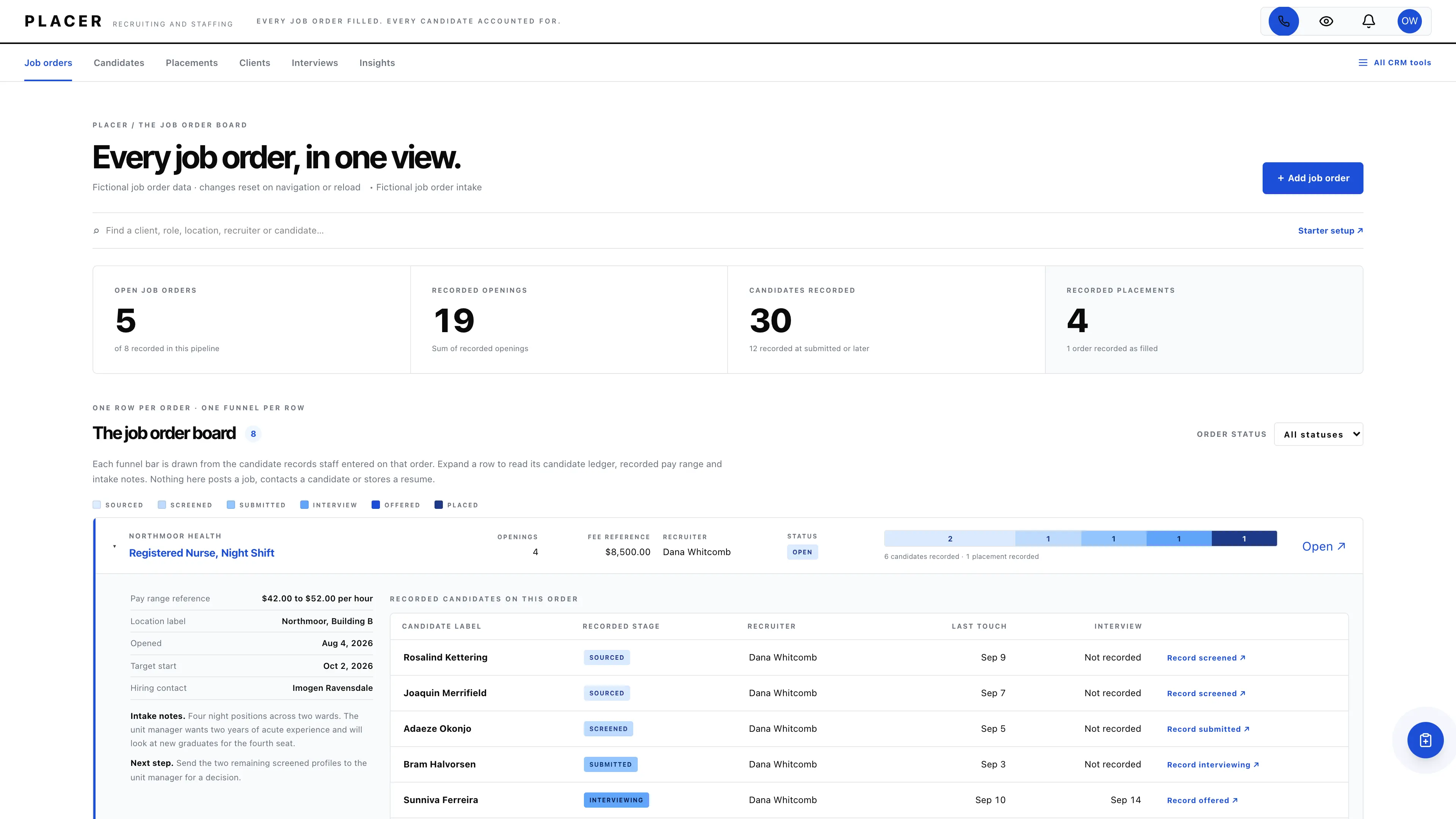
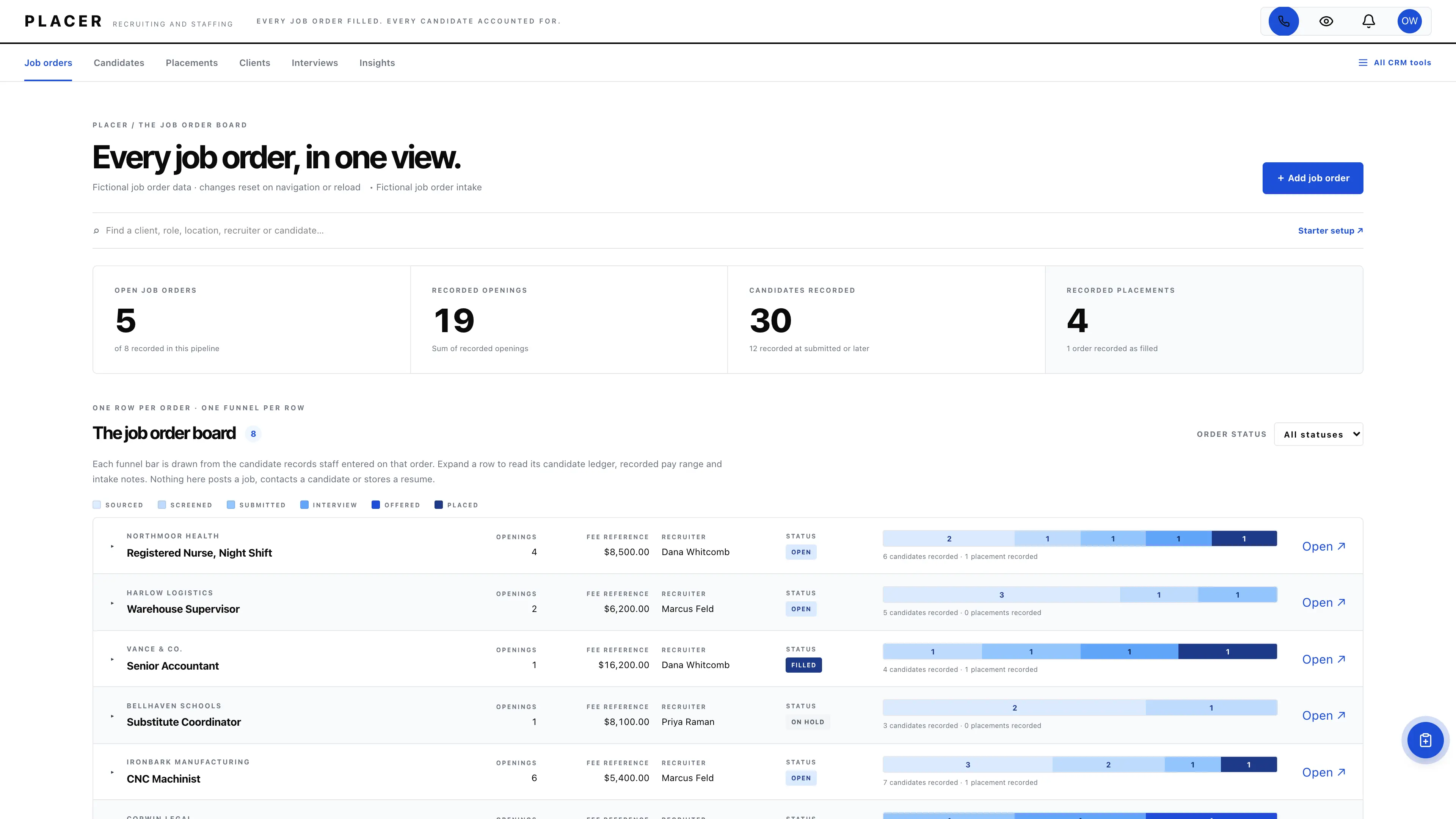
A staffing firm does not run one funnel. It runs one funnel per job order, and the work is knowing which order is thin at which stage. Placer gives every job order a wide row with its own segmented funnel bar, so a recruiting manager can see in one pass which orders need sourcing, which need submittals and which are waiting on a client.
Every job order is a wide row carrying the client label, the role title, the openings count, the recorded fee reference, the recruiter label, the order status and a funnel bar segmented by the recorded candidate stage counts. A row that is all pale blue has candidates sourced and nobody submitted. A row with a dark tail has somebody placed.
Expanding a row reveals that order’s candidate ledger inside the row: each candidate’s recorded stage, recruiter label, last touch date and interview date, beside the recorded pay range, location label, dates and intake notes. One control per candidate records the next stage.
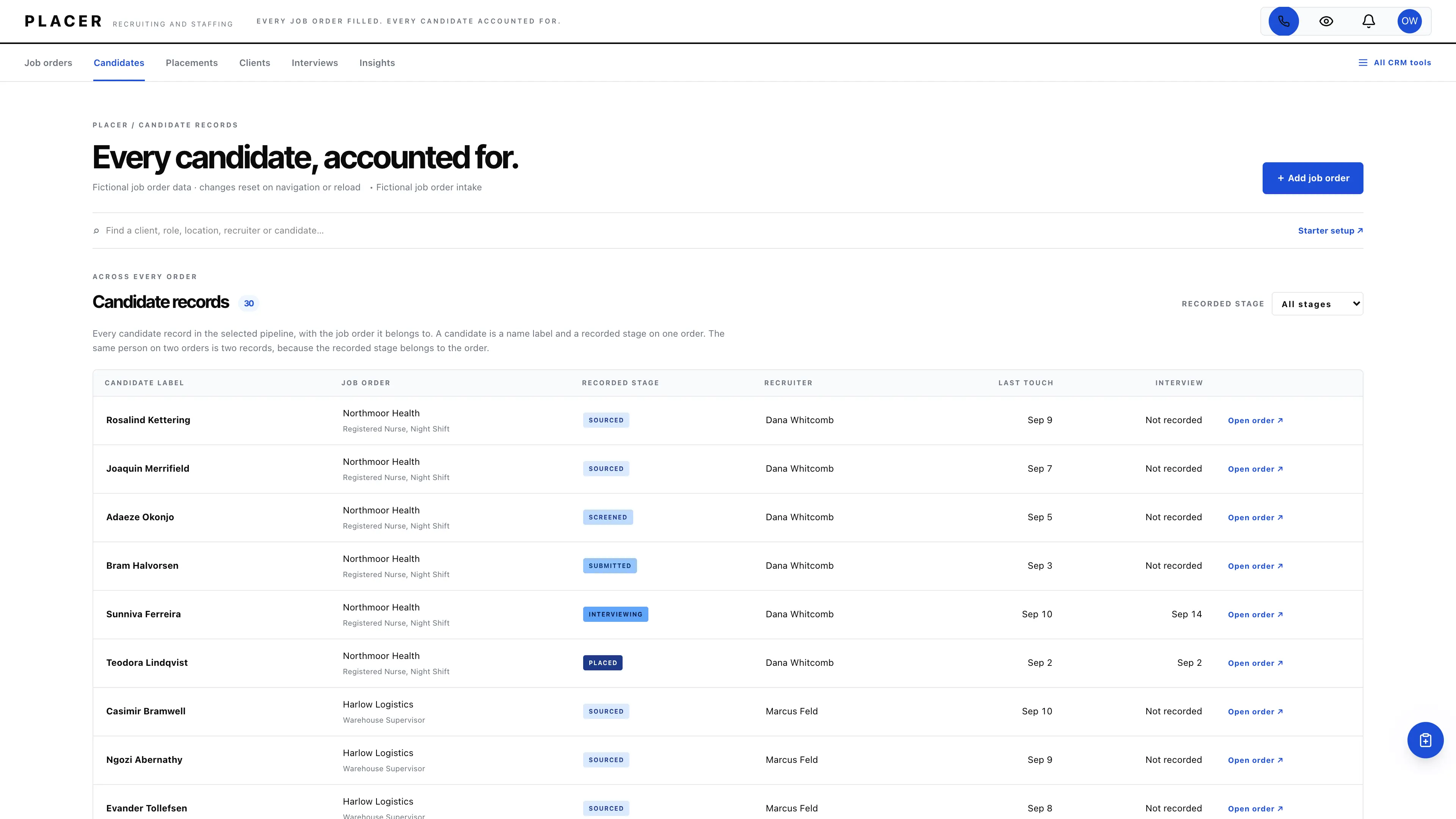
Every recorded candidate across every order in the selected pipeline, filterable by stage, with the order it belongs to. A candidate is a name label and one recorded stage on one job order. The same person on two orders is two records, because the recorded stage belongs to the order.
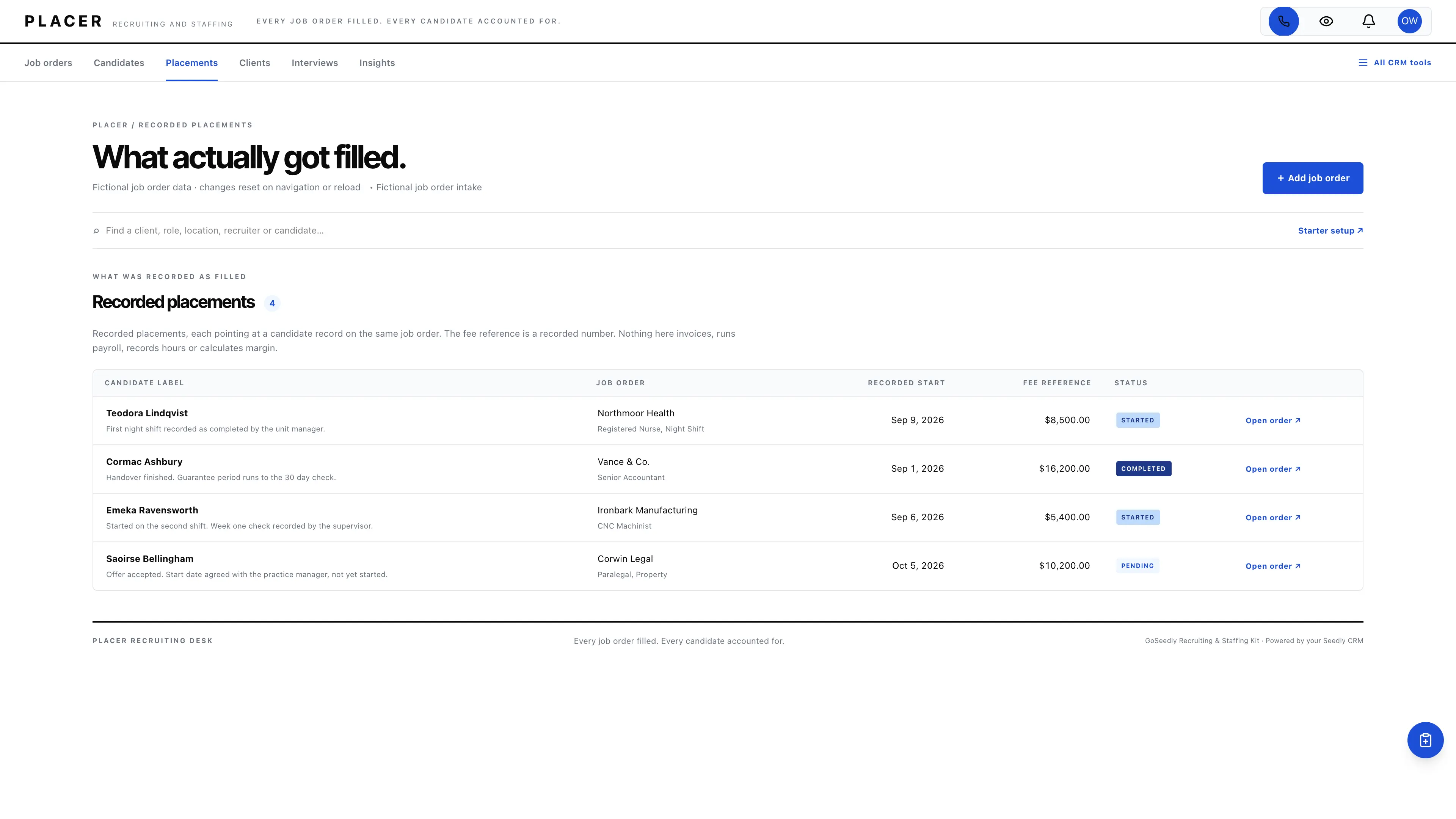
Recorded placements, each pointing at a candidate record on the same job order, with the recorded start date, the fee reference and a status of pending, started, completed or fell off. The fee reference is a recorded number. Nothing here invoices, runs payroll or records hours.
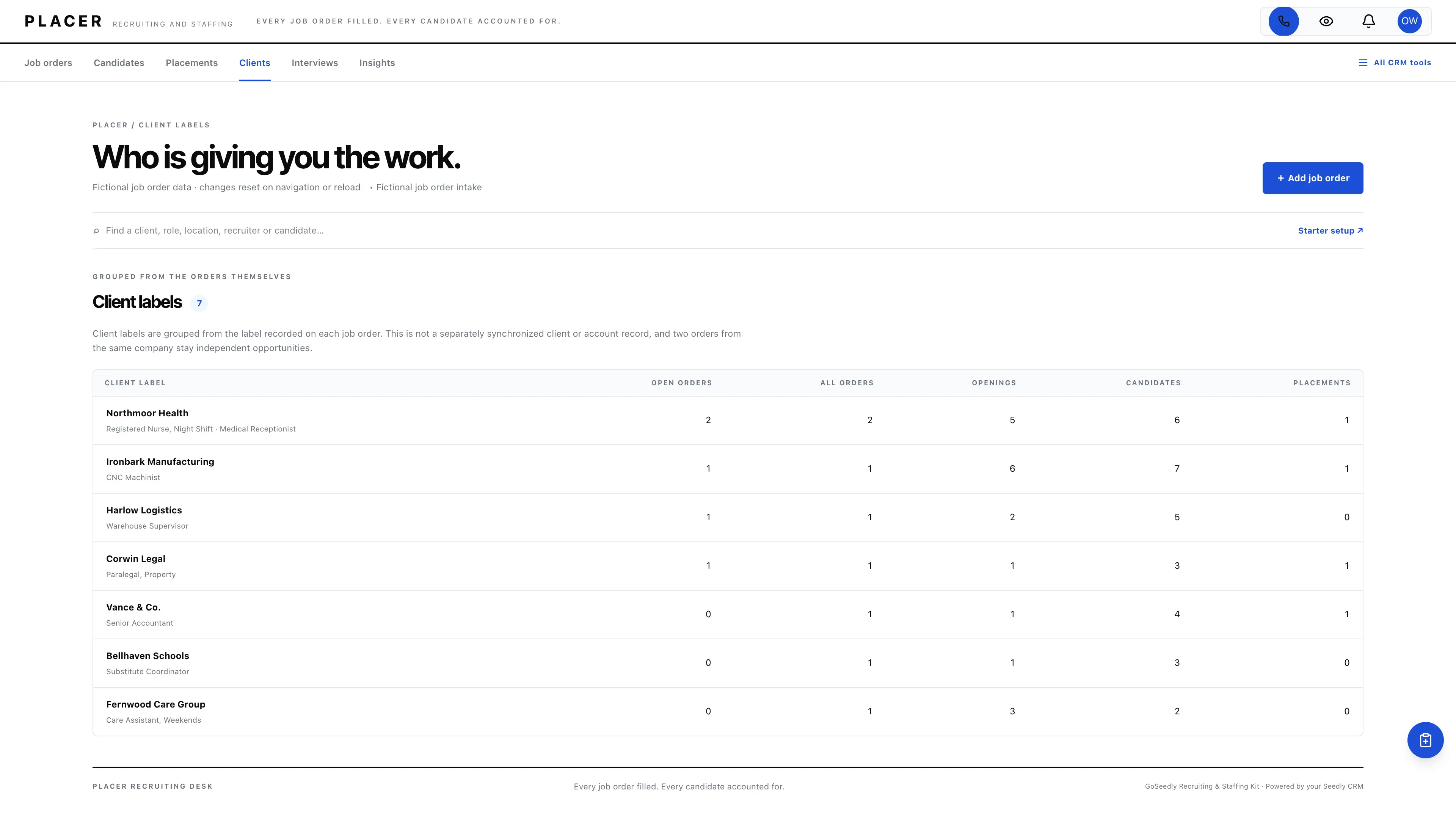
Client labels grouped from the orders themselves, with open order counts, total openings, recorded candidates and recorded placements per client. This is not a separately synchronized client record, and two orders from the same company stay independent opportunities.
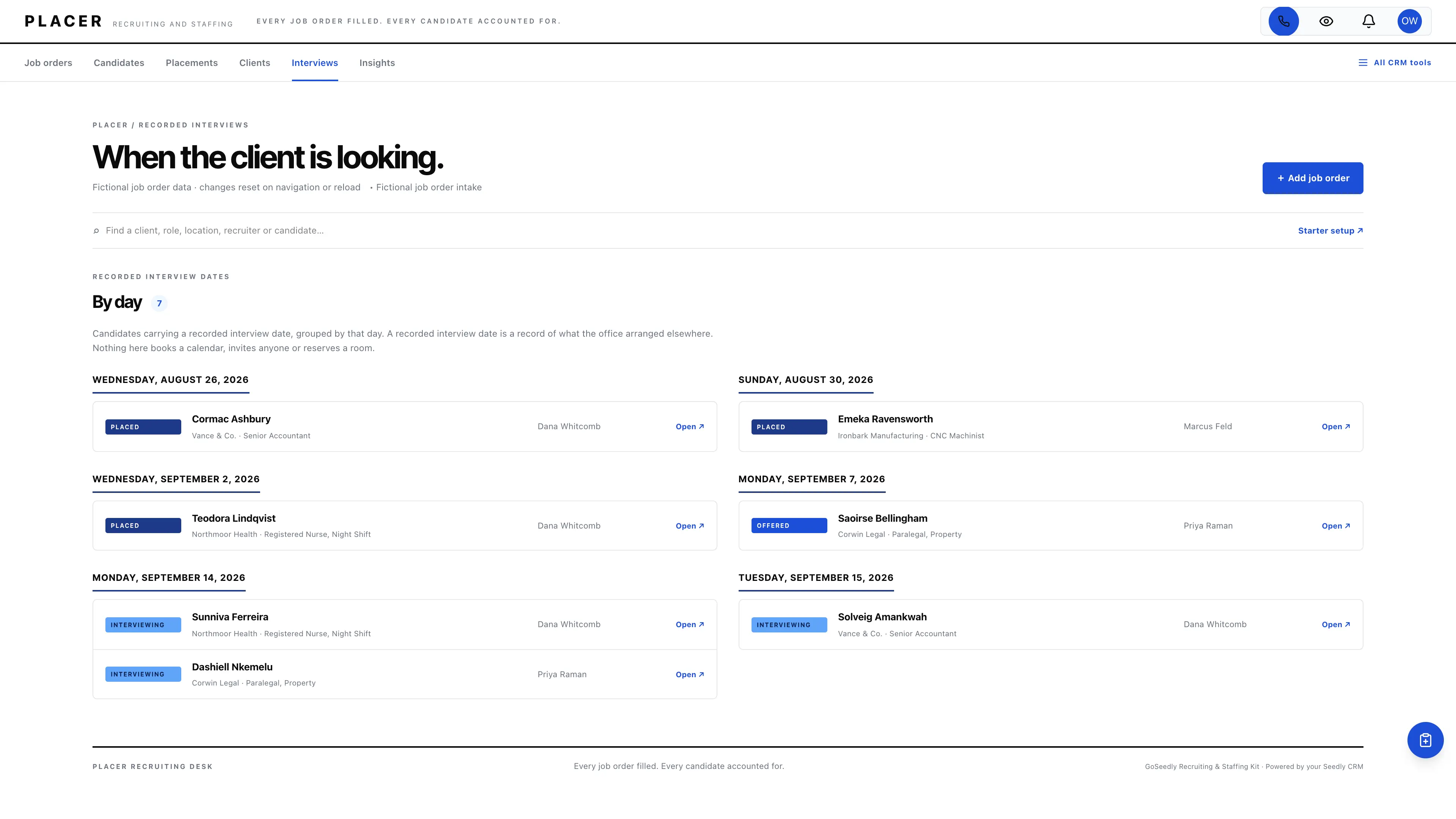
Candidates carrying a recorded interview date, grouped by that day, with the order, the recorded stage and the recruiter label. An interview date records what the office arranged elsewhere. Nothing here books a calendar, invites anyone or reserves a room.
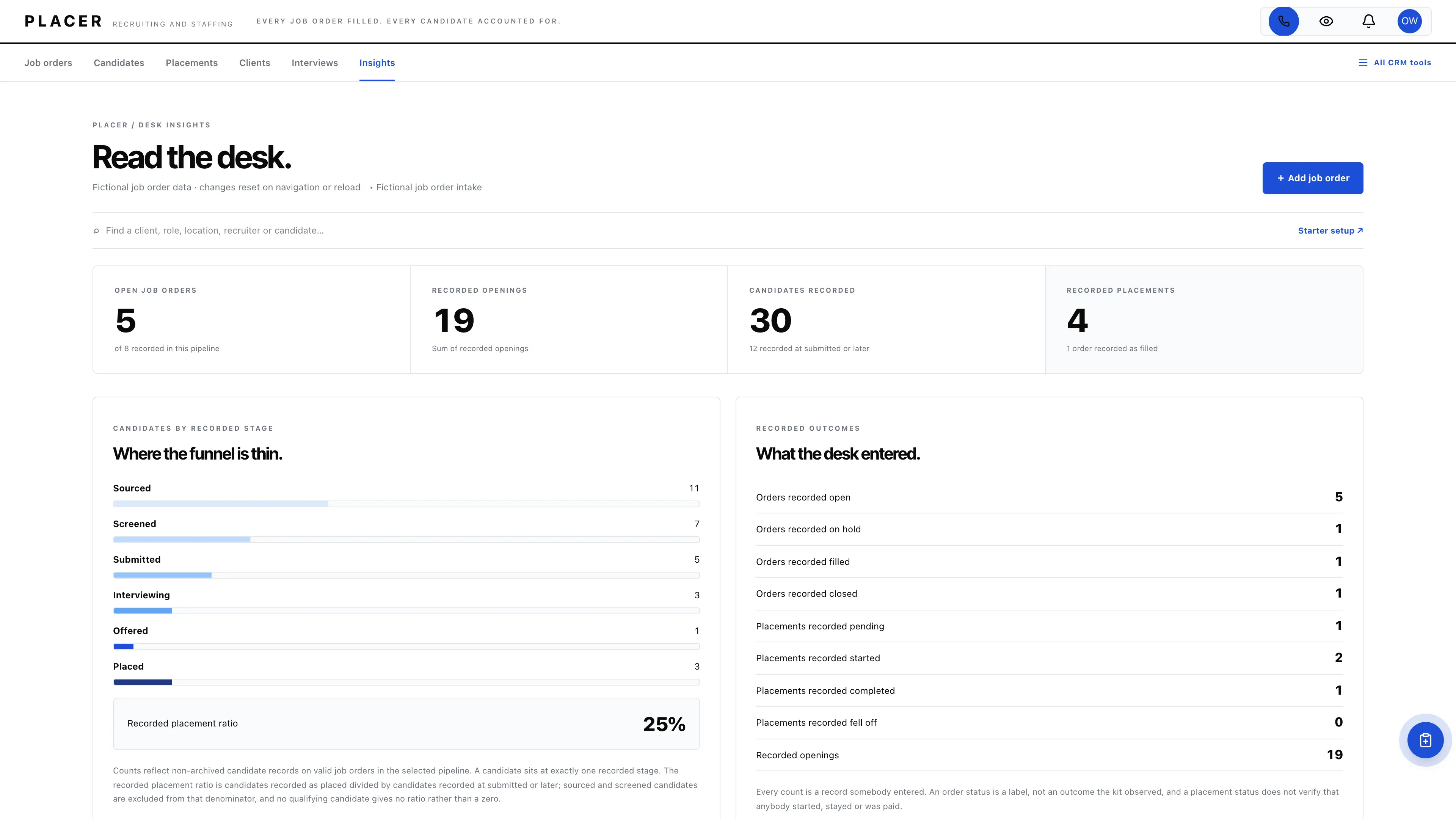
Candidate counts by recorded stage, orders by recorded status, placements by recorded status, recorded openings and the recorded placement ratio for the selected pipeline. Every number comes from a record somebody typed.
YOUR PROCESS, YOUR STARTING POINT
Useful structure. Only what you choose.
4 pipelines and 9 workflow drafts. Add the parts that match your work, with a separate sample view for exploring the interface.
01 / FOUR PIPELINES
Choose your starting structure.
Use a ready-made stage sequence or connect drafts to a suitable existing pipeline.
Job order intake · 8 stages
Candidate pipeline · 7 stages
Client development · 7 stages
Placement and onboarding · 7 stages
02 / NINE WORKFLOW DRAFTS
Give the next step a shape.
Intake call prep note
Sourcing kickoff task
Screen scheduling task
Submittal follow-up
Interview feedback task
Offer follow-up
Placement start check-in
30 day placement check task
Client account review note
Native trigger, task, wait, and note nodes provide editable examples. Every draft stays inactive until you review and publish it.
03 / SAMPLE WORKSPACE
Explore before adding records.
Explore eight fictional job orders with 30 recorded candidates spread across the six funnel stages, four recorded placements, and a brand new order with nobody sourced yet. Example edits stay in the current page’s memory and reset on navigation or reload; sample orders are never inserted into your CRM.
No sample customers are inserted into your CRM.
Starter setup checks selected kit additions before removal and preserves edited records and live work.
THE KIT, UNPACKED
Your workspace. Your starting point. Your code to edit.
One job order is a native contact-linked opportunity with a recorded role title, client label, openings, location label, pay range references with a period label, fee reference, recruiter label, order status, opened and target start dates, intake notes and a next-step note. Candidates and placements are stable-ID child records. Unrelated custom fields are preserved and stale record versions are rejected.
Job order board with a segmented candidate funnel bar on every row
In-place row expansion into that order’s candidate ledger
Candidate, placement, client and interview record views
Desk insights drawn from recorded workspace data
White, black and blue Placer application frame with full CRM tools
Four optional pipeline templates and nine inactive workflow drafts
Eight fictional in-memory job orders with 30 candidates and four placements
Guided setup, compatibility report, and private rollback receipt
AI-agent documentation for customized installations
Original editable source, configuration, and tests
Run the guided setup from the extracted kit. Supported integrations can be installed directly; customized integration files get a reviewed merge.
02
Connect the required helper.
Deploy the included helper from your authoritative backend source before connected edits. Build your web app, then choose any optional pipelines and drafts you need.
03
Set up your own team.
Edit company name, descriptor, and default pipeline name. Sign in with your account and verify the workflows and permissions your team uses.
Compatibility and operational details
Seedly CRM 5.8.4 · extension API 1. Node.js 20 or newer. The installer checks supported integration-file versions and does not deploy your web app or backend. The included original recruiting helper is required for connected creation, editing and starter setup. It preserves native account permissions and unrelated custom fields, keeps the six recorded candidate stage keys and stable candidate and placement IDs, enforces the four cross-field rules, and checks the current record state before saving. Deploy it from your authoritative backend source before connected edits. Pipeline presets and workflow drafts remain optional.
This is not an applicant tracking system. It stores no resume, document or attachment, and parses nothing. Candidate names are labels your team types. It posts to no job board, receives no application, sends no email or SMS, runs no background or reference check, books no interview and creates no calendar appointment. It runs no payroll, records no hours or timesheets, issues no invoice and calculates no margin or commission. It guarantees no compliance of any kind. Four rules are checked on the server as well as in the editor: a pay range ceiling is never lower than its floor, an interview date needs the candidate at interviewing, offered or placed, a placement references a candidate on the same order, and an order recorded as filled needs at least one recorded placement.
Calling, messaging, signing, payments, and external integrations depend on your Seedly installation, account permissions, plan, and configured providers. Screenshots use sample data and reference imagery. Hosting, installation, and ongoing maintenance are your responsibility.
Checking access…
DEVLAUNCH ALL ACCESS
Every kit. And everything else.
DevLaunch All Access includes every GoSeedly CRM kit, all 195 available today, along with every class, course, and product we release, and private calls with Aaron.
All 195 CRM kits
Every published kit as original editable source, with optional pipelines, workflow drafts, and guided installers. Browse the kits
Every class, course, and product
The full DevLaunch library and software collection, plus each eligible release during your access year, added to your portal as it ships.
Private calls with Aaron
Bring the idea, the offer, or the bottleneck, and leave with a plan you can follow.
DevLaunch All Access
Want more than one kit? All Access covers the whole CRM kit library and the rest of what we make. See everything it includes on the All Access page.
For your own compatible Seedly CRM. Seedly software, hosting and installation services are separate. Each full-interface kit uses its own web installation.
BEFORE YOU MAKE IT YOURS
Good questions. Clear answers.
How do I receive the kit?+
Purchase securely through Whop. Your original source ZIP and installation documentation are delivered manually to the email used at checkout. This is a one-time purchase of this kit; Seedly software, hosting, and installation services are separate.
Does this include Seedly CRM?+
You obtain and configure Seedly separately. The kit adds original frontend screens, a shared theme, starter definitions, and integration instructions. It does not include Seedly’s codebase, license, hosting, or a separate CRM database.
Is this one connected workspace?+
Placer keeps its job order navigation across the original recruiting views and native CRM modules. Full CRM tools remain available within the same signed-in account and application theme. Contacts, Calendar, Estimates, Documents, and other full modules retain the functionality supplied by your own Seedly installation. Existing authored content and provider screens retain their own layouts.
Can I use it with existing customizations?+
Yes, with a compatibility review. The installer checks the supported integration files. Changed integration files need a reviewed merge; the included AI-agent guide explains how to preserve custom extensions, permissions, providers, and routes.
Do I have to import all the starter content?+
No. Choose individual pipelines and workflow drafts, use a compatible existing pipeline, or install none. Workflows remain inactive until reviewed and published. They use native triggers, internal tasks, optional notes, and timed waits. A wait does not verify task completion or recheck the current stage. The included drafts do not send customer messages.
Can I remove the examples and starter content?+
Sample records stay in memory and never create customers in your CRM. Leave sample mode to return to your account. Starter setup lets you review removal of unused kit additions; server checks retain edited or published workflows and pipelines with live work or references. Removing the frontend does not delete account records.
Can different subaccounts use different kits?+
The current design and branding apply to the whole web installation. Subaccounts still separate data and access. Use a separate web installation for another full-interface kit; running different kit designs by subaccount in one installation requires additional customization.
Selected excerpts from reviews of DevLaunch training, software, and services. Individual customer experiences across DevLaunch.
Your privacy, your choice.
We use essential storage to keep the site working. With your permission, we also use analytics and the Whop Pixel to understand visits and advertising results. Optional analytics stay off until you choose.
 01 / Job order board