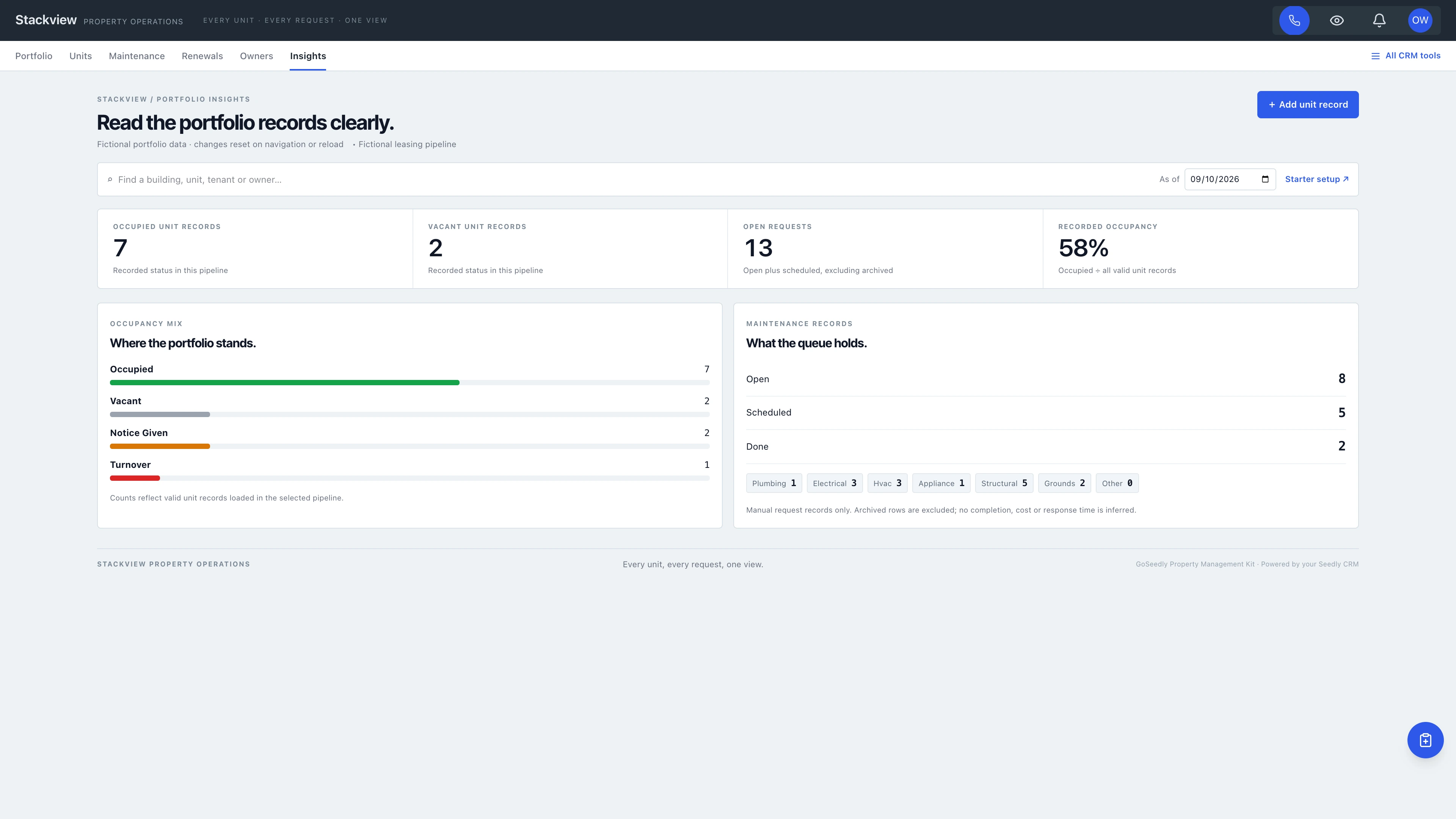
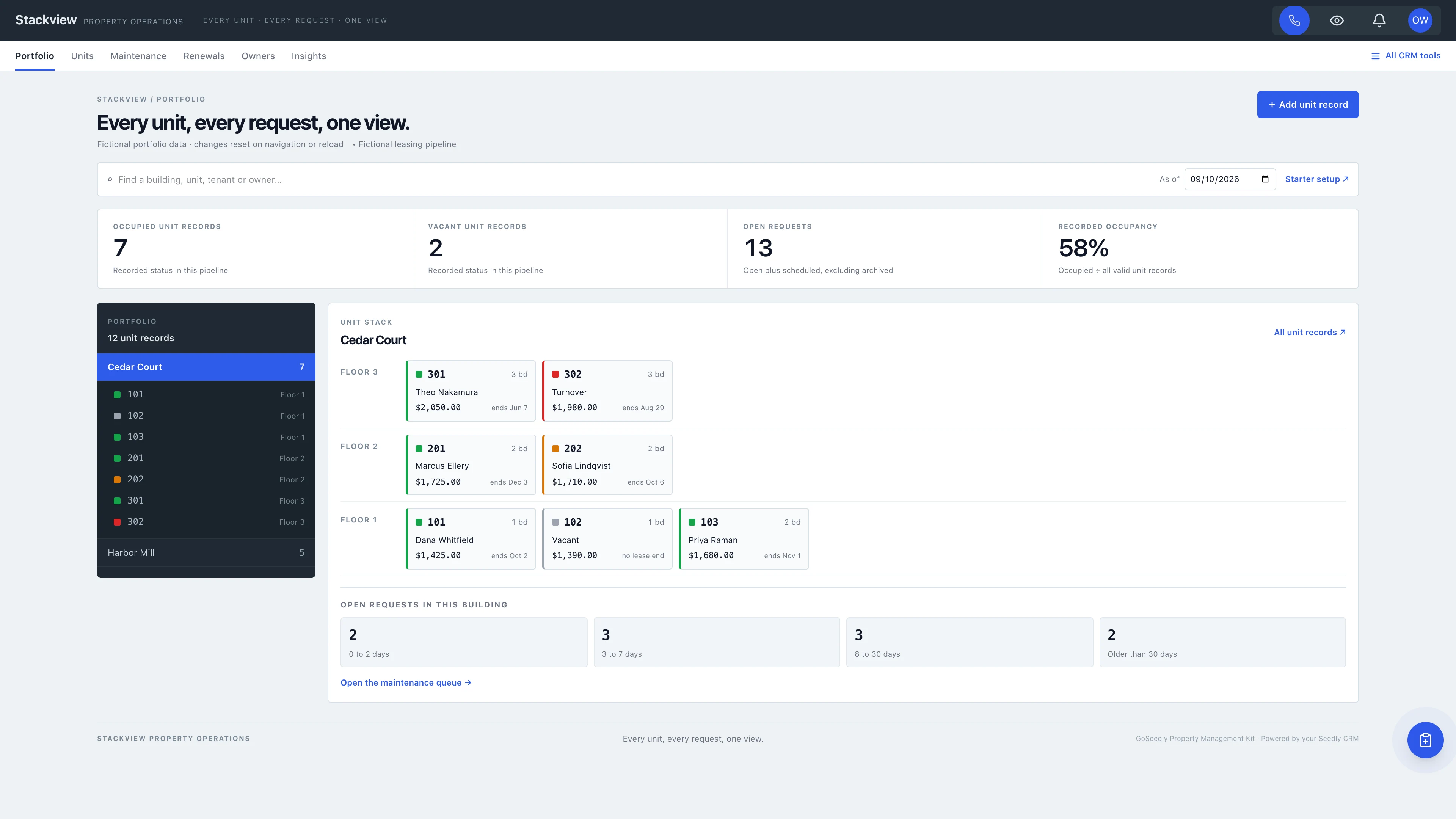
A property manager thinks in buildings and units. Stackview puts a graphite building tree beside a floor-ordered unit stack, then keeps the maintenance queue and lease renewal dates one click away.
The tree groups recorded building labels from your unit records. Choose one and its units lay out by recorded floor label with a status color, alongside an aging summary of that building’s open requests.
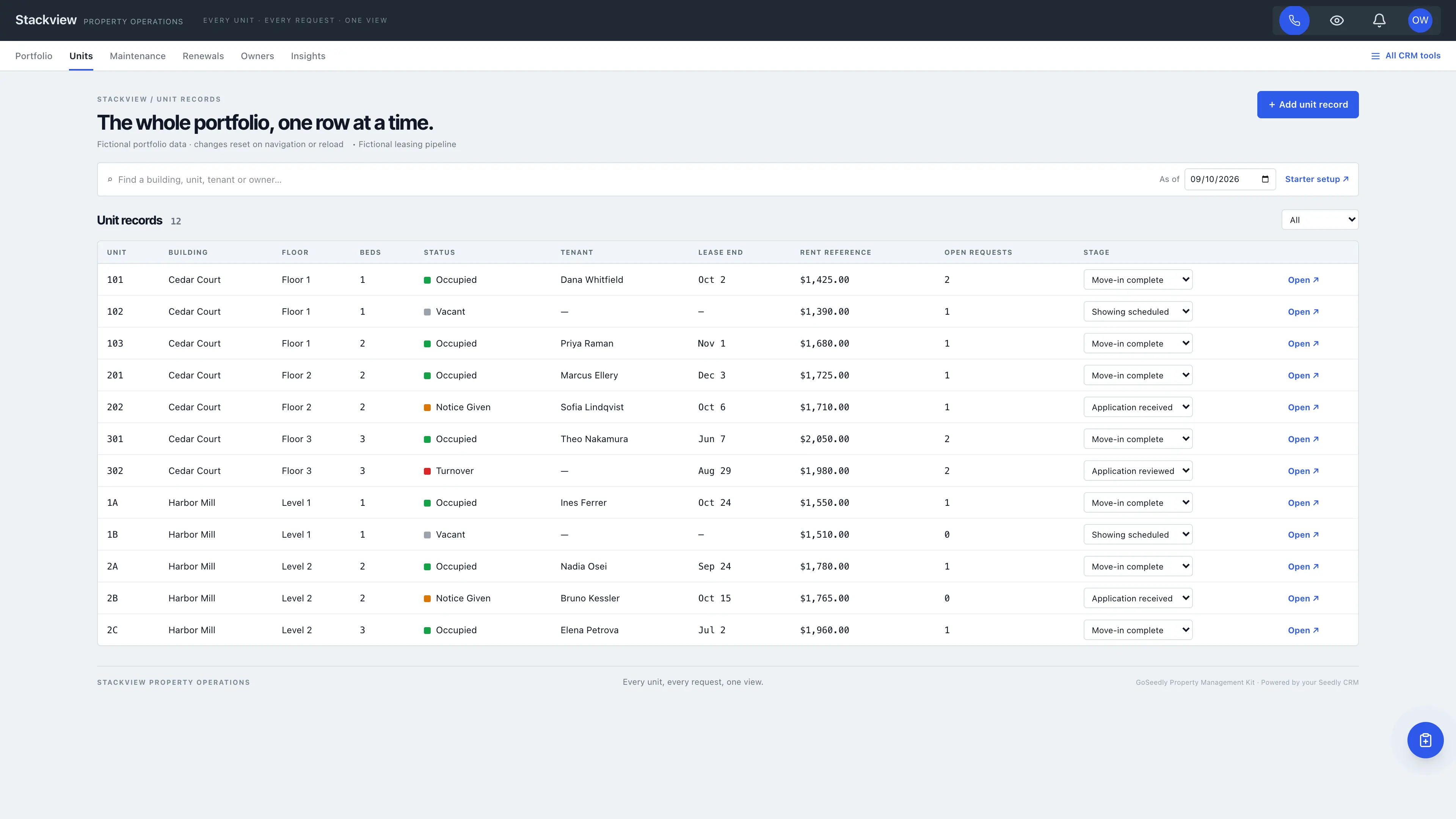
A dense table of every unit record with building, floor, bedrooms, status, tenant label, lease end, rent reference and open request count. Filter by recorded status and change the native pipeline stage in place.
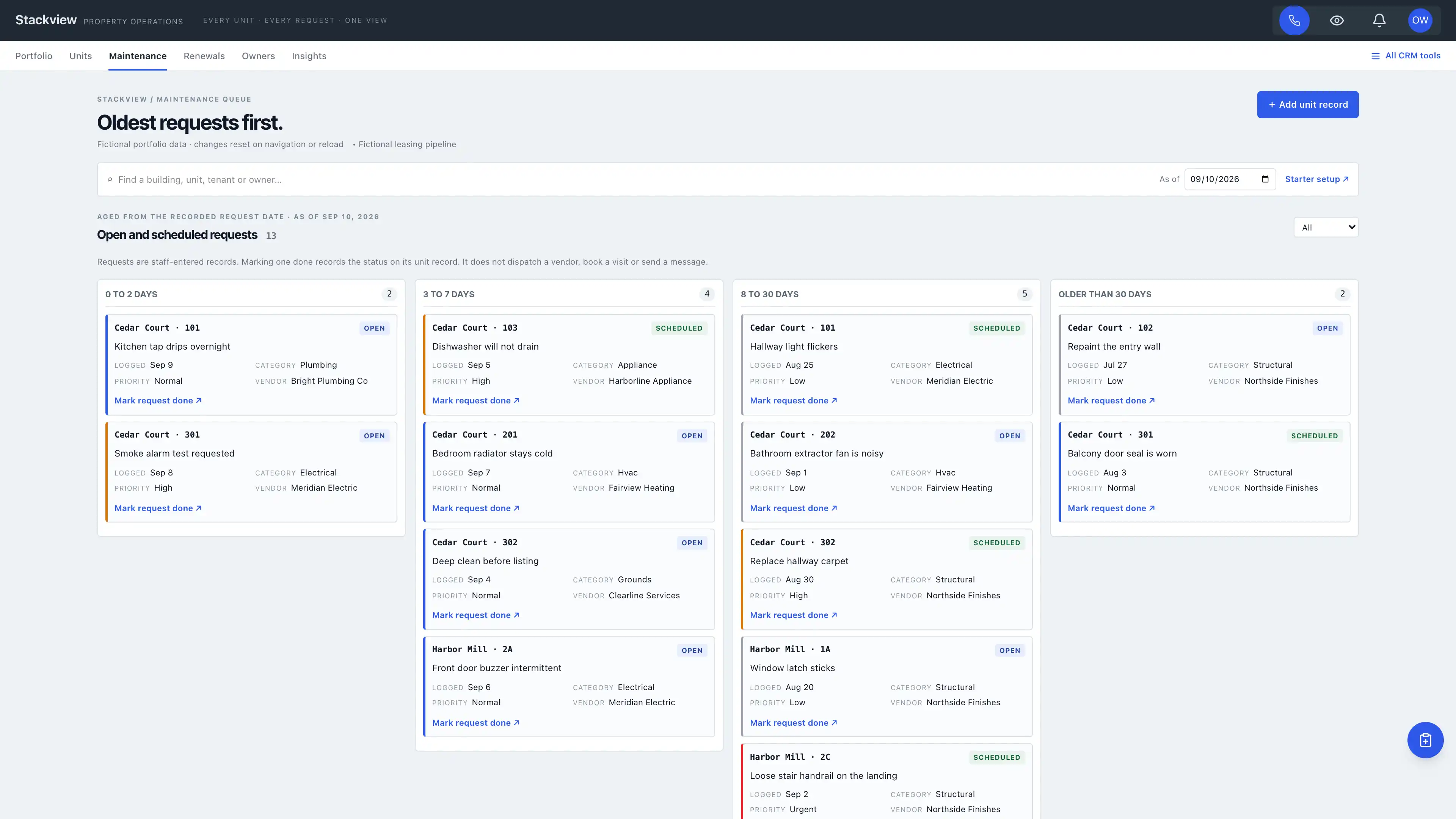
Open and scheduled requests fall into four aging buckets measured from the recorded request date against the date you choose: 0 to 2 days, 3 to 7, 8 to 30, and older. Filter by category and record one as done.
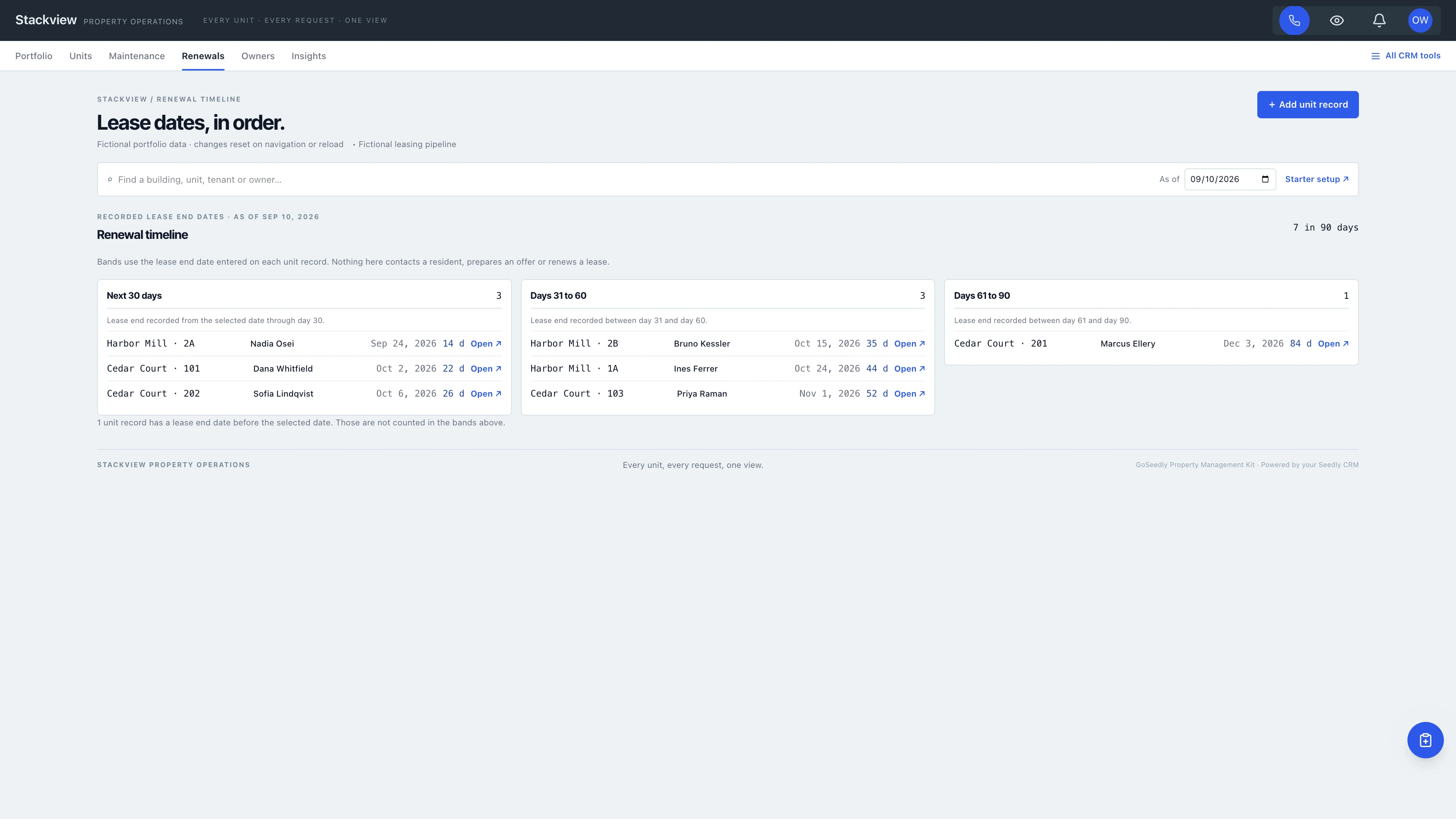
Recorded lease end dates land in the next 30, 60 and 90 days from the selected date, with the day count beside each unit. Lease ends that already passed are counted separately rather than folded into a band.
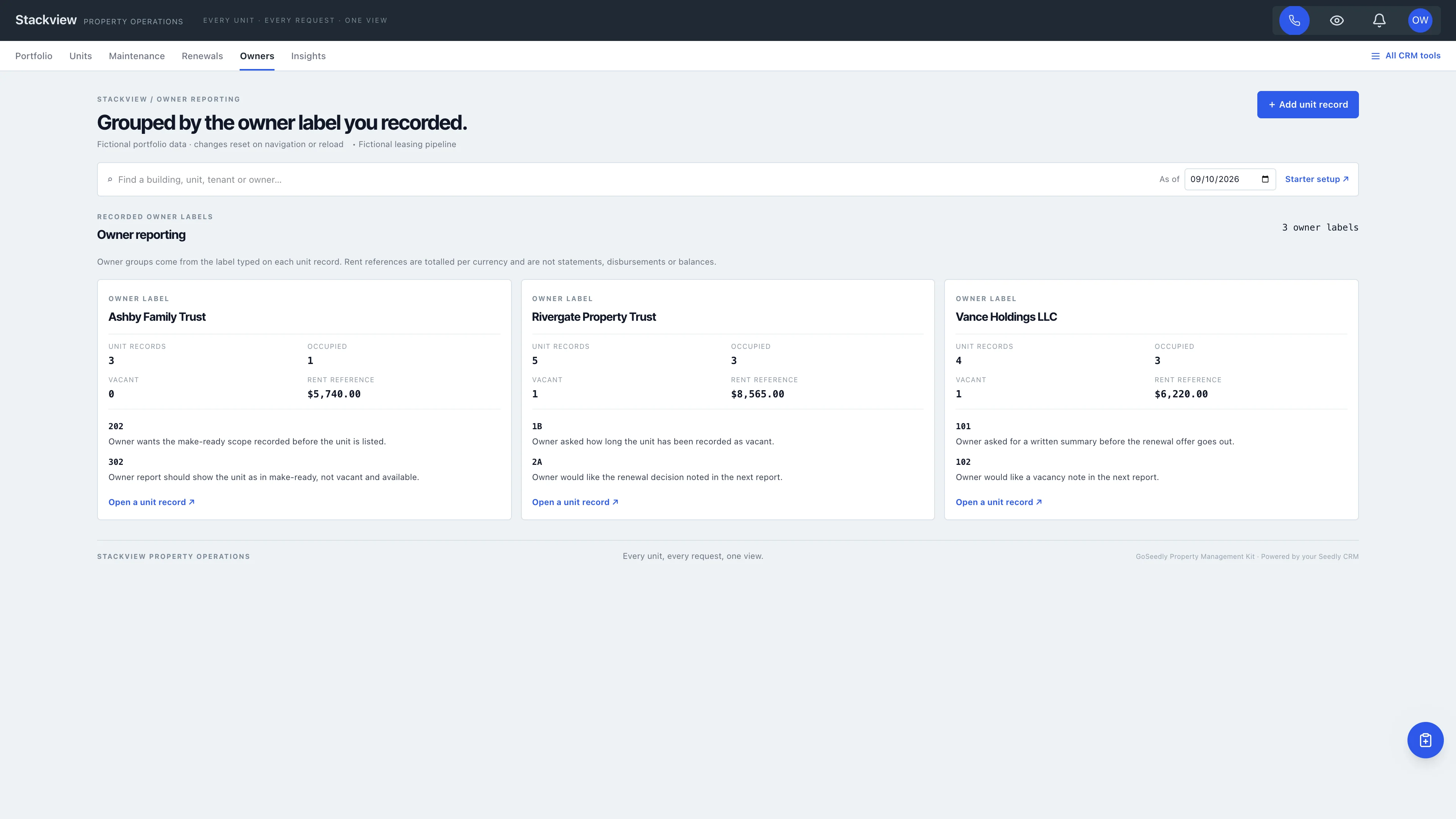
Owner groups come from the owner label typed on each unit record, with the occupied and vacant split, rent reference totals per currency, and the reporting notes your team entered against each unit.
Occupancy mix and maintenance record counts for the selected pipeline, by status and by category. The numbers stay tied to entered records rather than treating rent references as collected revenue.
YOUR PROCESS, YOUR STARTING POINT
Useful structure. Only what you choose.
4 pipelines and 9 workflow drafts. Add the parts that match your work, with a separate sample view for exploring the interface.
01 / FOUR PIPELINES
Choose your starting structure.
Use a ready-made stage sequence or connect drafts to a suitable existing pipeline.
Leasing and move-in · 8 stages
Maintenance request · 7 stages
Lease renewal · 7 stages
Turnover and make-ready · 7 stages
02 / NINE WORKFLOW DRAFTS
Give the next step a shape.
Application review
Move-in checklist
Request triage
Vendor follow-up
90-day renewal outreach
60-day renewal reminder
Notice to vacate checklist
Make-ready inspection
Owner report review
Native trigger, task, wait, and note nodes provide editable examples. Every draft stays inactive until you review and publish it.
03 / SAMPLE WORKSPACE
Explore before adding records.
Explore twelve fictional unit records across two fictional buildings, with fifteen maintenance requests, recorded lease dates and owner labels. Example edits stay in the current page’s memory and reset on navigation or reload; sample units are never inserted into your CRM.
No sample customers are inserted into your CRM.
Starter setup checks selected kit additions before removal and preserves edited records and live work.
THE KIT, UNPACKED
Your workspace. Your starting point. Your code to edit.
One unit record is a native contact-linked opportunity holding namespaced building, unit and floor labels, bedrooms, recorded status, tenant label, lease start and end dates, an optional monthly rent reference, an owner label, unit notes, an owner reporting note and individually recorded maintenance requests.
Portfolio tree with a floor-ordered unit stack grid
Dense unit table with status filter and native stage control
Maintenance queue with four aging buckets from recorded request dates
Lease renewal timeline at 30, 60 and 90 days
Owner reporting groups and portfolio insights
Graphite and cobalt Stackview frame with full CRM tools
Four optional pipeline templates and nine inactive workflow drafts
Twelve fictional in-memory unit records and fifteen maintenance requests
Guided setup, compatibility report, and private rollback receipt
AI-agent documentation for customized installations
Original editable source, configuration, and tests
Run the guided setup from the extracted kit. Supported integrations can be installed directly; customized integration files get a reviewed merge.
02
Connect the required helper.
Deploy the included helper from your authoritative backend source before connected edits. Build your web app, then choose any optional pipelines and drafts you need.
03
Set up your own team.
Edit company name, descriptor, and default pipeline name. Sign in with your account and verify the workflows and permissions your team uses.
Compatibility and operational details
Seedly CRM 5.8.4 · extension API 1. Node.js 20 or newer. The installer checks supported integration-file versions and does not deploy your web app or backend. The included original property management helper is required for connected creation, editing and starter setup. It preserves native account permissions and unrelated custom fields, and checks the current record timestamp and revision before saving. Deploy it from your authoritative backend source before connected edits. Pipeline presets and workflow drafts remain optional.
Occupancy status, tenant labels, owner labels and maintenance requests are staff-entered records. The kit does not collect rent, produce statements, run accounting or make owner disbursements; the recorded monthly rent is a reference figure separate from opportunity value and payments. It does not sign leases, run a tenant portal, dispatch vendors or schedule inspections. Vendor labels are recorded text, and marking a request done records that status only. Aging buckets and renewal bands recompute from the date you choose in the workspace; they are not predictions or automatic outreach.
Calling, messaging, signing, payments, and external integrations depend on your Seedly installation, account permissions, plan, and configured providers. Screenshots use sample data and reference imagery. Hosting, installation, and ongoing maintenance are your responsibility.
Checking access…
DEVLAUNCH ALL ACCESS
Every kit. And everything else.
DevLaunch All Access includes every GoSeedly CRM kit, all 195 available today, along with every class, course, and product we release, and private calls with Aaron.
All 195 CRM kits
Every published kit as original editable source, with optional pipelines, workflow drafts, and guided installers. Browse the kits
Every class, course, and product
The full DevLaunch library and software collection, plus each eligible release during your access year, added to your portal as it ships.
Private calls with Aaron
Bring the idea, the offer, or the bottleneck, and leave with a plan you can follow.
DevLaunch All Access
Want more than one kit? All Access covers the whole CRM kit library and the rest of what we make. See everything it includes on the All Access page.
For your own compatible Seedly CRM. Seedly software, hosting and installation services are separate. Each full-interface kit uses its own web installation.
BEFORE YOU MAKE IT YOURS
Good questions. Clear answers.
How do I receive the kit?+
Purchase securely through Whop. Your original source ZIP and installation documentation are delivered manually to the email used at checkout. This is a one-time purchase of this kit; Seedly software, hosting, and installation services are separate.
Does this include Seedly CRM?+
You obtain and configure Seedly separately. The kit adds original frontend screens, a shared theme, starter definitions, and integration instructions. It does not include Seedly’s codebase, license, hosting, or a separate CRM database.
Is this one connected workspace?+
Stackview keeps its portfolio navigation across the original property management views and native CRM modules. Full CRM tools remain available within the same signed-in account and application theme. Contacts, Calendar, Estimates, Documents, and other full modules retain the functionality supplied by your own Seedly installation. Existing authored content and provider screens retain their own layouts.
Can I use it with existing customizations?+
Yes, with a compatibility review. The installer checks the supported integration files. Changed integration files need a reviewed merge; the included AI-agent guide explains how to preserve custom extensions, permissions, providers, and routes.
Do I have to import all the starter content?+
No. Choose individual pipelines and workflow drafts, use a compatible existing pipeline, or install none. Workflows remain inactive until reviewed and published. They use native triggers, internal tasks, optional notes, and timed waits. A wait does not verify task completion or recheck the current stage. The included drafts do not send customer messages.
Can I remove the examples and starter content?+
Sample records stay in memory and never create customers in your CRM. Leave sample mode to return to your account. Starter setup lets you review removal of unused kit additions; server checks retain edited or published workflows and pipelines with live work or references. Removing the frontend does not delete account records.
Can different subaccounts use different kits?+
The current design and branding apply to the whole web installation. Subaccounts still separate data and access. Use a separate web installation for another full-interface kit; running different kit designs by subaccount in one installation requires additional customization.
Selected excerpts from reviews of DevLaunch training, software, and services. Individual customer experiences across DevLaunch.
Your privacy, your choice.
We use essential storage to keep the site working. With your permission, we also use analytics and the Whop Pixel to understand visits and advertising results. Optional analytics stay off until you choose.
 01 / Portfolio