Skip to content
View packages
CRM Kits Dog trainers

GoSeedly Dog Trainer Kit

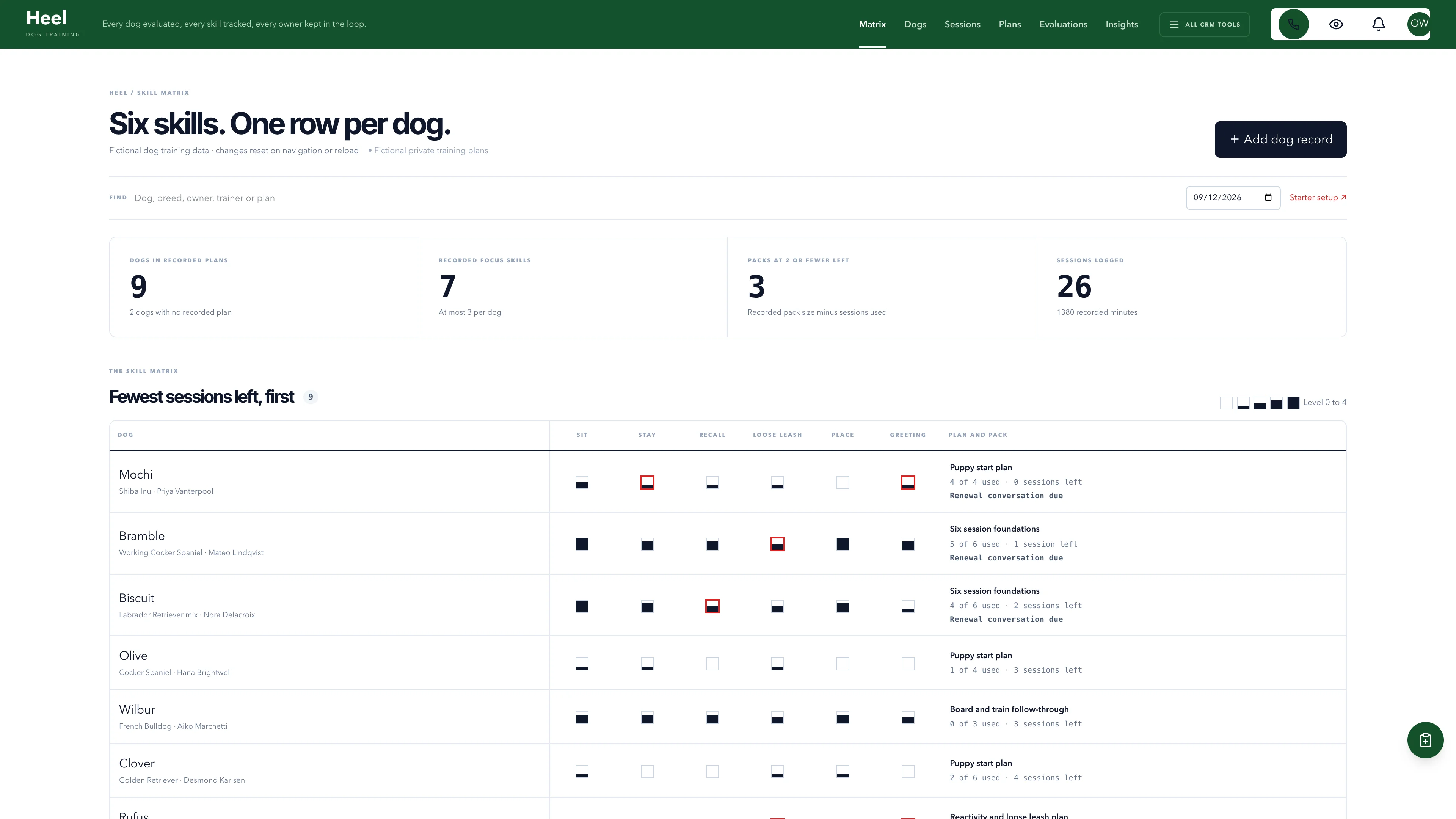
Six skills. One row per dog.
The pack at the end of the row.

A dog trainer does not sell a stage. She evaluates a dog, writes a plan, sells a pack of sessions, and then spends six weeks moving six specific skills up one notch at a time. The question she is asked every week is not where the deal sits. It is how he is doing on recall, and how many sessions are left. So Heel makes the row the dog, the columns the six core skills, and every cell a small square filled in quarters for the level somebody last recorded. The end of the row says how much of the pack has been used, and a pack with two sessions left says so in red, because that is a conversation that has to happen this week.

Checking access…See the interface
One-time purchase · USD · Your Seedly backend · Editable kit source

YOUR SKILL MATRIX

01 — SKILL MATRIX
Dog training skill matrix with one row per dog, six skill columns of quarter-filled squares, and the recorded plan and pack at the end of each row, using fictional sample data

Actual interface captures with fictional sample data. Open a screenshot for a closer look.

TAKE A CLOSER LOOK

From the first evaluation to the last session in the pack.

One connected workspace, with views built around the decisions your team makes each day.

Skill matrix in the GoSeedly Dog Trainer Kit with fictional sample records01 / Skill matrix

Fewest sessions left, first.

Every dog in a recorded plan as one row, ordered so the packs about to run out sit at the top. Six skill columns in small caps, a quarter-filled square in every cell for the recorded level 0 to 4, and a red ring on any skill flagged as the current focus. The row ends in the recorded plan, the sessions used out of the pack size, and the sessions left. Four tiles above it read the dogs in recorded plans, the recorded focus skills, the packs at two or fewer left and the sessions logged.

Dog sheet in the GoSeedly Dog Trainer Kit with fictional sample records02 / Dog sheet

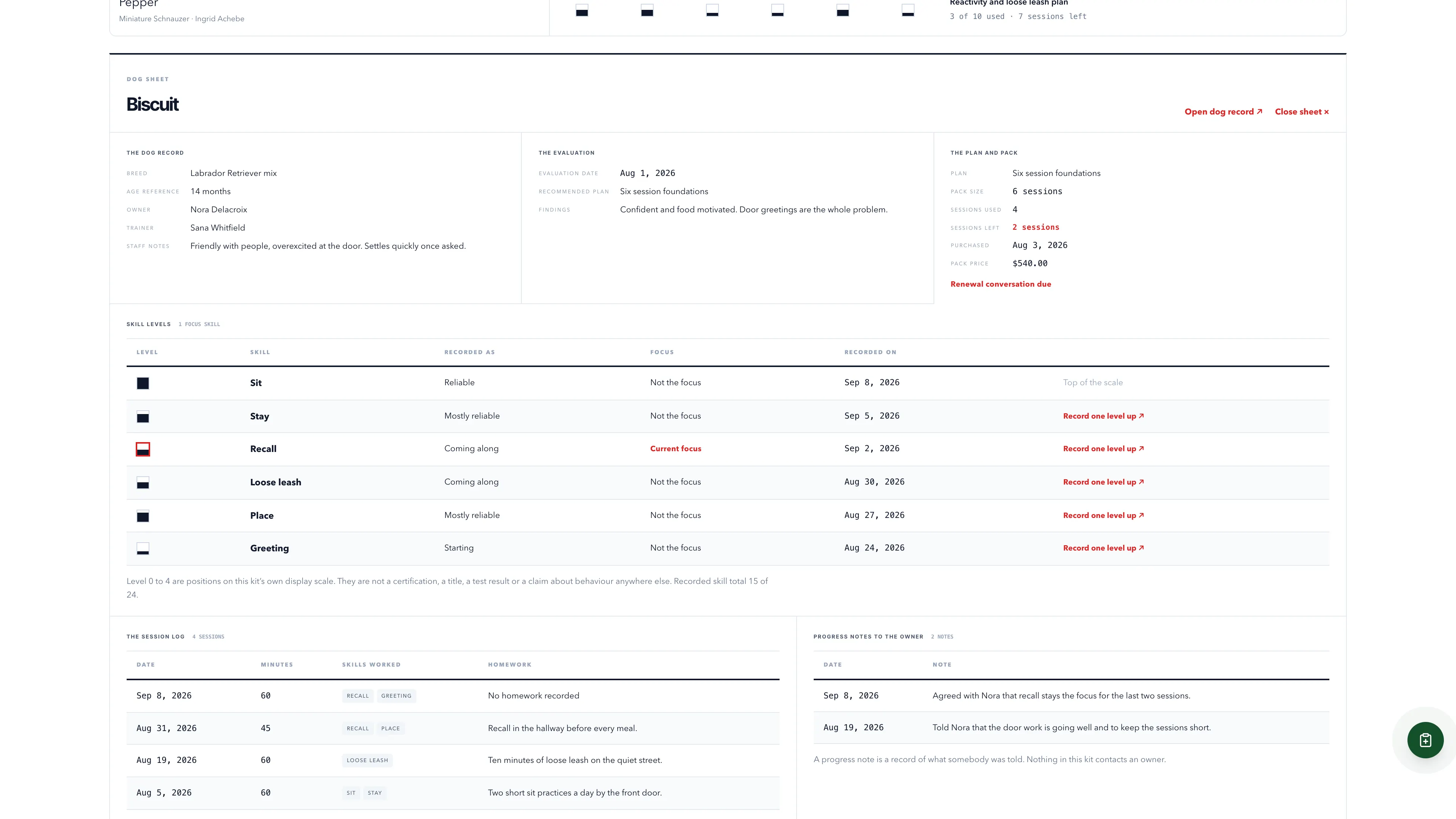
Selecting a row opens the dog.

The sheet opens under the matrix with the dog name in its own head, so the dog never leaves the screen. Six ruled blocks: the dog record with the breed, age, owner, trainer and the staff notes on temperament; the evaluation with its date, findings and recommended plan; the plan and pack with the sessions left and the renewal flag; all six skill levels with the level in words and the date each was recorded; the session log; and the progress notes to the owner.

Dogs in the GoSeedly Dog Trainer Kit with fictional sample records03 / Dogs

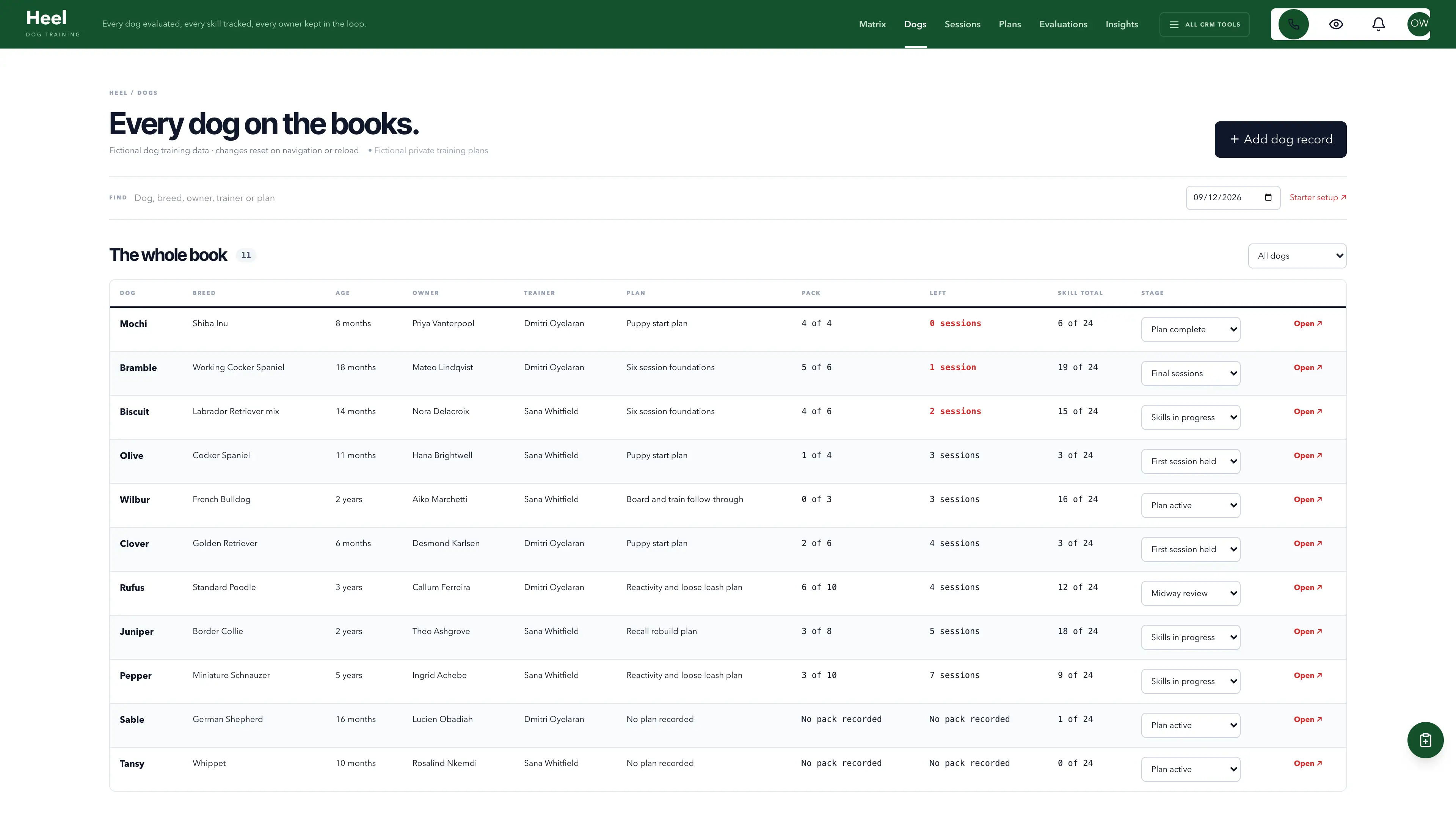
Every dog on the books.

The whole book in one table, by name, with the breed label, age reference, owner, trainer, recorded plan, the pack as used out of size, the sessions left and the recorded skill total out of 24. Filter to the dogs in a recorded plan, the dogs with no recorded plan, or all of them. The stage select beside each row is the keyboard and assistive equivalent of moving the card in your CRM.

Session log in the GoSeedly Dog Trainer Kit with fictional sample records04 / Session log

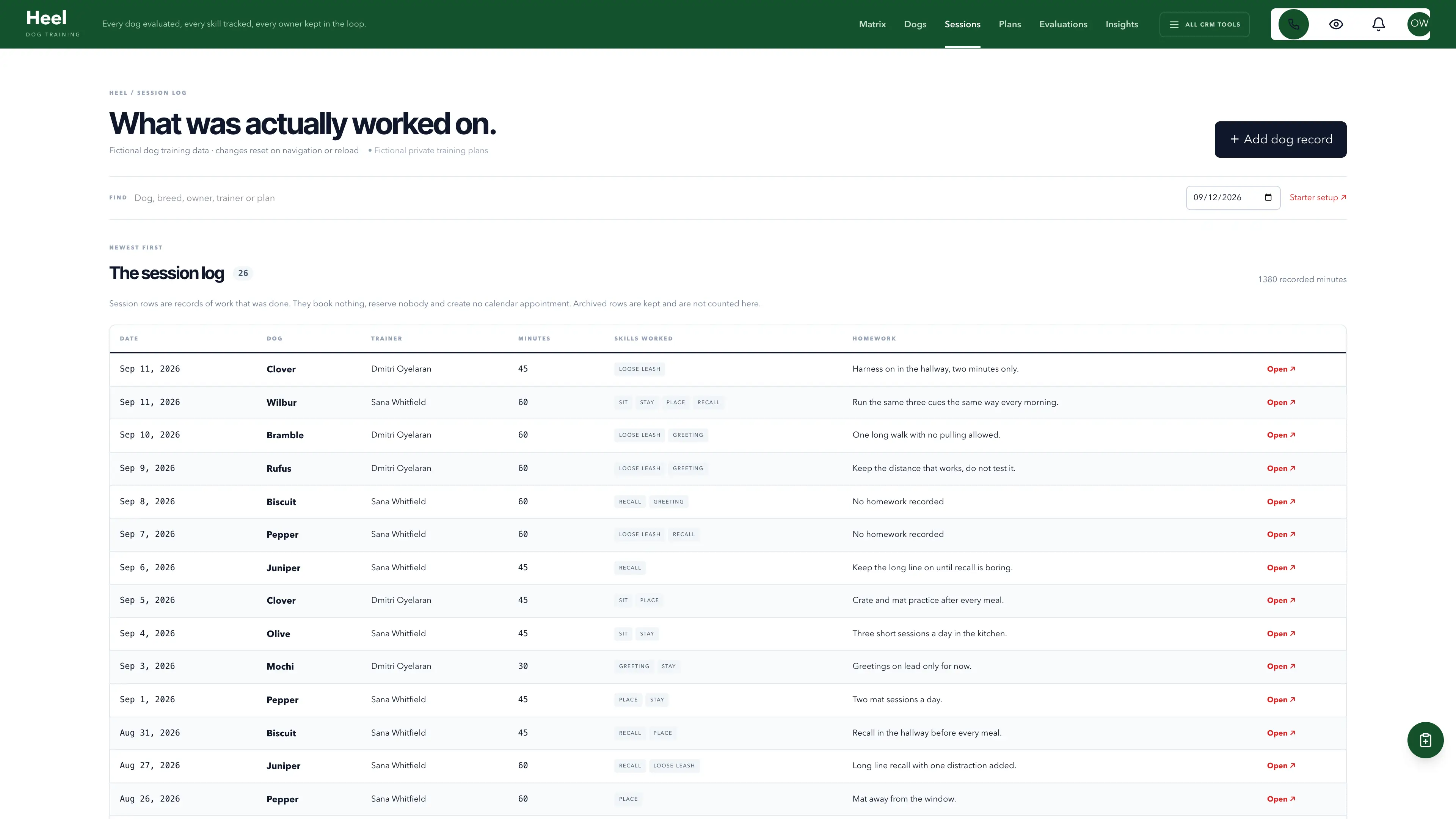
What was actually worked on.

Every recorded session row across the loaded records as one table, newest first, with its date, the dog, the trainer label, the recorded duration in minutes, the skills worked as small caps chips, and the recorded homework note. This is the log to read when the question is what has been done rather than what the plan says. Archived rows are kept and are not counted here.

Plans and packs in the GoSeedly Dog Trainer Kit with fictional sample records05 / Plans and packs

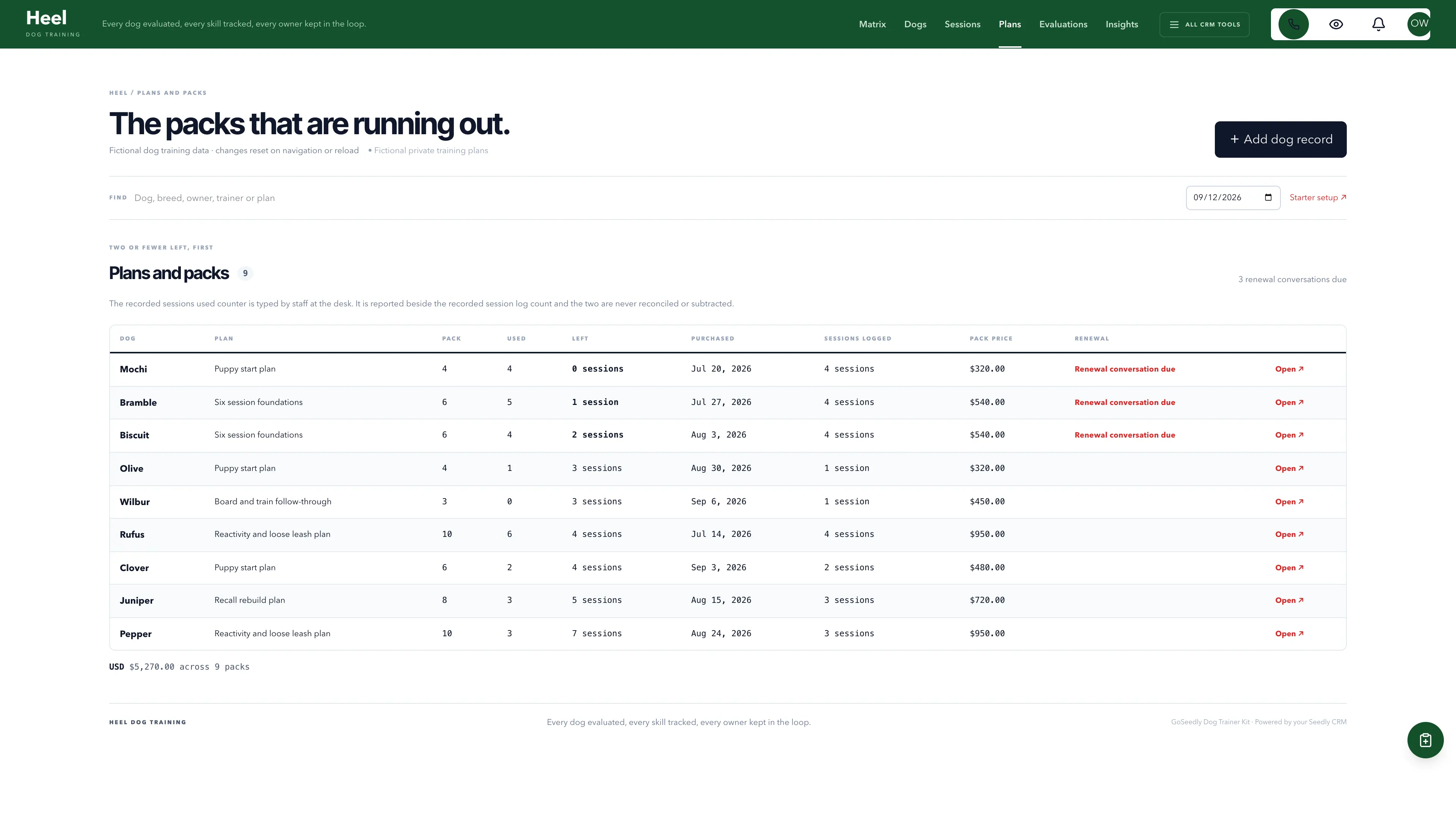
The packs that are running out.

The recorded packs with two or fewer sessions left at the top, carrying the recorded pack size, the sessions used, the sessions left, the purchase date, the session log count beside the counter, the recorded pack price and the renewal words in red. Recorded pack totals are grouped by currency code and never added across currencies.

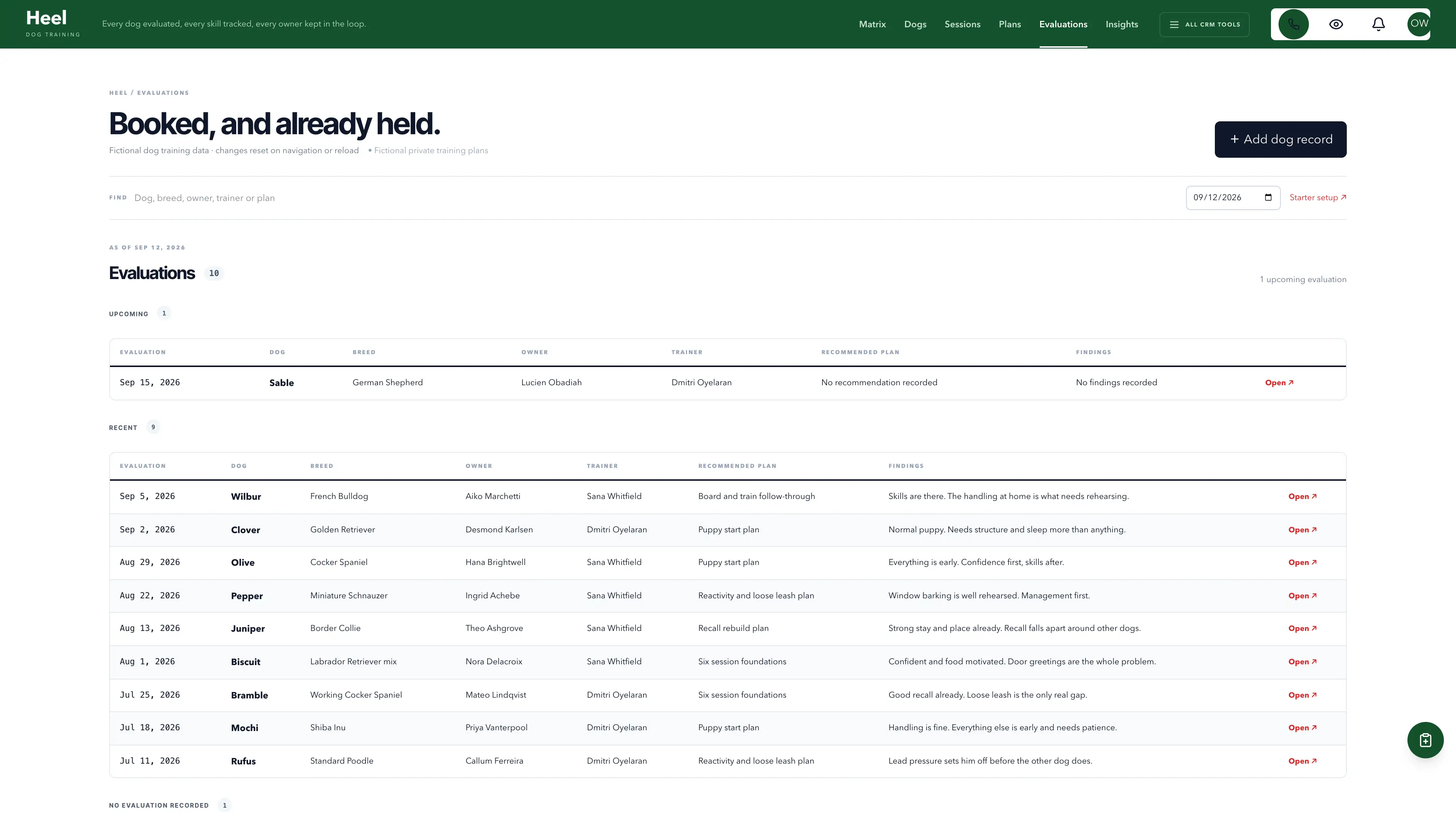
Evaluations in the GoSeedly Dog Trainer Kit with fictional sample records06 / Evaluations

Booked, and already held.

The recorded evaluations in three ruled groups against the selected date: upcoming by date ascending, recent by date descending, and the records that record no evaluation date at all, so a dog nobody has booked anything for is visible instead of invisible. Each row carries the date, the dog, the breed, the owner, the trainer, the recommended plan and the recorded findings.

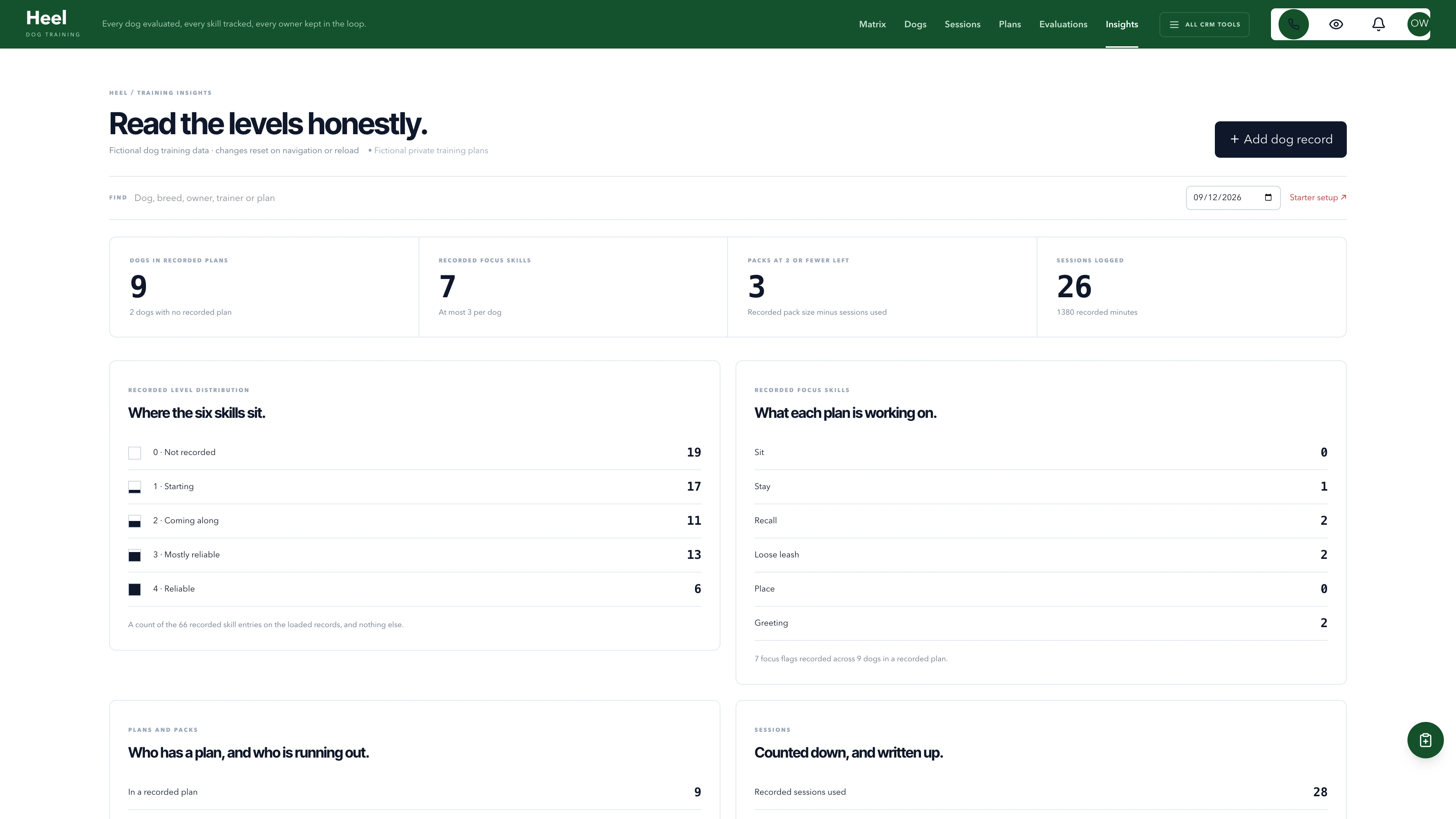
Insights in the GoSeedly Dog Trainer Kit with fictional sample records07 / Insights

Read the levels honestly.

The recorded level distribution across all six skills drawn as the same quarter-filled squares with their counts, the recorded focus skills by skill, the dogs in recorded plans against the dogs with no plan, the packs at two or fewer sessions left, the recorded sessions used reported beside the recorded session log rows and never subtracted from them, the recorded minutes, and recorded pack totals grouped by currency.

YOUR PROCESS, YOUR STARTING POINT

Useful structure.
Only what you choose.

4 pipelines and 9 workflow drafts. Add the parts that match your work, with a separate sample view for exploring the interface.

01 / FOUR PIPELINES

Choose your starting structure.

Use a ready-made stage sequence or connect drafts to a suitable existing pipeline.

  1. Evaluations and new dogs · 8 stages
  2. Private training plans · 7 stages
  3. Group classes and puppy programs · 7 stages
  4. Board and train · 7 stages
02 / NINE WORKFLOW DRAFTS

Give the next step a shape.

  • Evaluation booking task
  • Evaluation recorded note
  • Plan proposal follow-up
  • First session reminder
  • Homework check-in task
  • Two sessions remaining task
  • Progress update to owner task
  • Pack renewal follow-up
  • Graduation note

Native trigger, task, wait, and note nodes provide editable examples. Every draft stays inactive until you review and publish it.

03 / SAMPLE WORKSPACE

Explore before adding records.

Explore eleven fictional dogs, nine of them in five recorded plans and two with no plan yet, so the no-plan strip has something real to show. Their sixty-six skill entries spread across all five levels 0 to 4, so every state of the quarter-filled square is visible without editing anything, and seven of them carry the focus flag so the red ring appears in more than one row. Three packs record two or fewer sessions left, so the red plan column and the renewal words both appear. The set carries twenty-six logged session rows plus two archived rows, twelve owner notes and two trainer labels. Example edits stay in the current page’s memory and reset on navigation or reload; sample dogs are never inserted into your CRM.

No sample customers are inserted into your CRM.

Starter setup checks selected kit additions before removal and preserves edited records and live work.

THE KIT, UNPACKED

Your workspace.
Your starting point.
Your code to edit.

One dog in training is a native contact-linked opportunity with a namespaced dog name, breed label, age reference, owner label, trainer label, staff notes, an evaluation (date, findings, recommended plan), a plan and pack (plan label, pack size, sessions used, purchase date, pack price), an immutable supported currency, a fixed ordered set of six skills, and two archive-only child collections with stable IDs: session rows with a date, a duration in minutes, the skills worked and a homework note, and owner note rows with a date and a note. The recorded pack price stays separate from native opportunity value. Other custom fields are preserved.

A skill progress matrix of dogs against the six core skills, fewest sessions left first
A quarter-filled CSS square for every recorded level 0 to 4, with a red ring on the current focus
The level written as a word beside the square, so no reading depends on colour or shape alone
A plan column that reads the recorded pack and flags two or fewer sessions left in words
A dog sheet that opens in place with the record, the evaluation, the pack, all six levels, the session log and the owner notes
Session log, plans and packs, evaluations and insights views across every loaded record
Archive-only session and owner note rows with stable IDs, so nothing somebody recorded is ever erased
A single forest chrome bar over a white canvas with full permission-filtered CRM tools
Four optional pipeline templates and nine inactive workflow drafts
Eleven fictional in-memory dogs with 66 skill entries, 26 logged sessions and 12 owner notes
Guided setup, compatibility report, and private rollback receipt
AI-agent documentation for customized installations
Original editable source, configuration, and tests
Read the installation guide

FROM KIT TO CONNECTED WORKSPACE

Check. Connect.
Make it yours.

01

Check your Seedly project.

Run the guided setup from the extracted kit. Supported integrations can be installed directly; customized integration files get a reviewed merge.

02

Connect the required helper.

Deploy the included helper from your authoritative backend source before connected edits. Build your web app, then choose any optional pipelines and drafts you need.

03

Set up your own team.

Edit company name, descriptor, promise line, and default pipeline name. Sign in with your account and verify the workflows and permissions your team uses.

Compatibility and operational details

Seedly CRM 5.8.4 · extension API 1. Node.js 20 or newer. The installer checks supported integration-file versions and does not deploy your web app or backend. The included original dog record helper is required for connected creation, editing and starter setup. It preserves native account permissions and unrelated custom fields, keeps the six skills a fixed ordered set, re-checks every cross-field rule, and compares the current record state before saving. It exposes no stage mutation at all, so pipeline stages stay in your CRM’s own views under your existing roles. Deploy the helper from your authoritative backend source before connected edits. Pipeline presets and workflow drafts remain optional.

The six skills are a fixed ordered set, sit, stay, recall, loose leash, place and greeting, and a save that adds, removes, renames or reorders them is refused, because the matrix only works if every row has the same columns. A skill level is a whole number from 0 to 4 and a position on this kit’s own four step display scale: it is not a certification, a title, a test result, a standardised assessment or a claim about a dog’s behaviour in any other setting, and the level is written as a word beside every square so the display never depends on colour or shape alone. The recorded sessions used counter is a number staff type at the desk; it is not derived from the session log, and the two are reported beside each other and never reconciled or subtracted, because a trainer counts a pack down at the desk and writes the log up in the field. Cross-field rules are identical on create and on save and re-checked by the server: a recorded plan needs a recorded evaluation date, a pack purchase date may not precede the evaluation, sessions used may not exceed the pack size, a price needs a pack, a skill recorded at the top level may not also be the current focus, a recorded level needs the date it was recorded, and at most three of the six skills may carry the focus flag at once. Three non-rules are deliberate: a session date is not constrained against the pack purchase date because a dog is often seen before the pack is bought, two sessions may share a date, and skill levels are never constrained against each other or against the number of logged sessions. A recorded evaluation date, session date or trainer label reserves nobody and creates no calendar appointment: there is no scheduling engine, availability check, capacity model or calendar sync. There is no payment processing, pack selling, invoicing, refund or credit balance anywhere, no training methodology, curriculum, behaviour protocol, behaviour advice, aggression assessment or temperament test, no veterinary, medical, health, vaccination, medication or insurance record of any kind, no owner messaging of any kind, and no video, photo or media library. Recorded pack totals are grouped by currency and never added across currencies. The pipeline stage stays your CRM’s own: the helper exposes no stage mutation at all, so recording a skill level never moves a card and moving a card never changes a skill level.

Calling, messaging, signing, payments, and external integrations depend on your Seedly installation, account permissions, plan, and configured providers. Screenshots use sample data and reference imagery. Hosting, installation, and ongoing maintenance are your responsibility.
Checking access…

DEVLAUNCH ALL ACCESS

Every kit.
And everything else.

DevLaunch All Access includes every GoSeedly CRM kit, all 195 available today, along with every class, course, and product we release, and private calls with Aaron.

  • All 195 CRM kits

    Every published kit as original editable source, with optional pipelines, workflow drafts, and guided installers. Browse the kits

  • Every class, course, and product

    The full DevLaunch library and software collection, plus each eligible release during your access year, added to your portal as it ships.

  • Private calls with Aaron

    Bring the idea, the offer, or the bottleneck, and leave with a plan you can follow.

DevLaunch All Access

Want more than one kit? All Access covers the whole CRM kit library and the rest of what we make. See everything it includes on the All Access page.

See DevLaunch All Access

Already a member? Open your downloads.

For your own compatible Seedly CRM. Seedly software, hosting and installation services are separate. Each full-interface kit uses its own web installation.

BEFORE YOU MAKE IT YOURS

Good questions.
Clear answers.

How do I receive the kit?+

Purchase securely through Whop. Your original source ZIP and installation documentation are delivered manually to the email used at checkout. This is a one-time purchase of this kit; Seedly software, hosting, and installation services are separate.

Does this include Seedly CRM?+

You obtain and configure Seedly separately. The kit adds original frontend screens, a shared theme, starter definitions, and integration instructions. It does not include Seedly’s codebase, license, hosting, or a separate CRM database.

Is this one connected workspace?+

Heel keeps its dog training navigation in one chrome bar across the original matrix views and native CRM modules. Full CRM tools remain available within the same signed-in account and application theme. Contacts, Calendar, Estimates, Documents, and other full modules retain the functionality supplied by your own Seedly installation. Existing authored content and provider screens retain their own layouts.

Can I use it with existing customizations?+

Yes, with a compatibility review. The installer checks the supported integration files. Changed integration files need a reviewed merge; the included AI-agent guide explains how to preserve custom extensions, permissions, providers, and routes.

Do I have to import all the starter content?+

No. Choose individual pipelines and workflow drafts, use a compatible existing pipeline, or install none. Workflows remain inactive until reviewed and published. They use native triggers, internal tasks, optional notes, and timed waits. A wait does not verify task completion or recheck the current stage. The included drafts do not send customer messages.

Can I remove the examples and starter content?+

Sample records stay in memory and never create customers in your CRM. Leave sample mode to return to your account. Starter setup lets you review removal of unused kit additions; server checks retain edited or published workflows and pipelines with live work or references. Removing the frontend does not delete account records.

Can different subaccounts use different kits?+

The current design and branding apply to the whole web installation. Subaccounts still separate data and access. Use a separate web installation for another full-interface kit; running different kit designs by subaccount in one installation requires additional customization.

Customer experiences / Trustpilot

What customers say
about DevLaunch.

Read all reviews on Trustpilot ↗

Selected excerpts from reviews of DevLaunch training, software, and services. Individual customer experiences across DevLaunch.