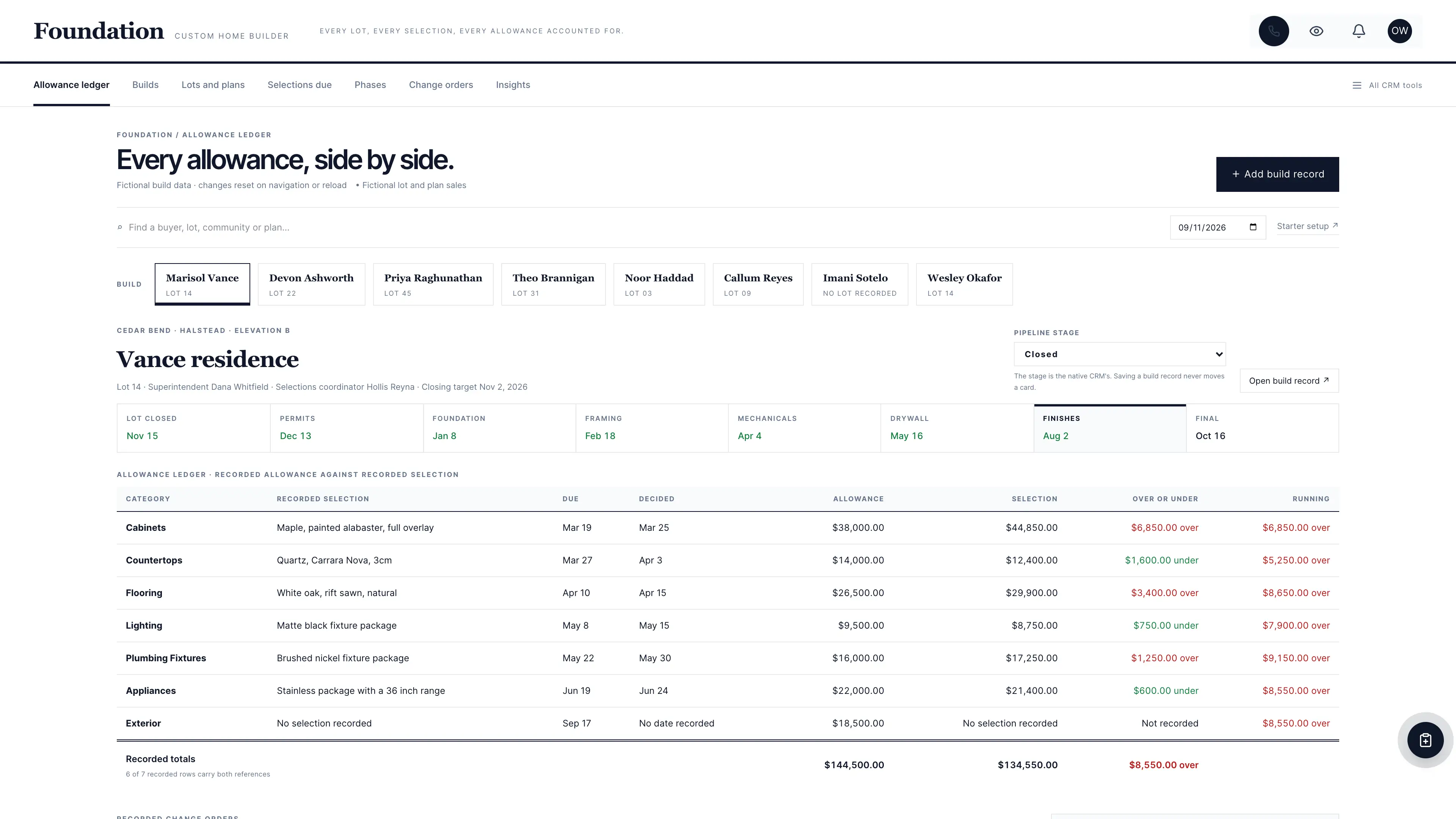
Put the gap between the allowance and the selection on the screen. Foundation is a ruled ledger on paper white: the recorded allowance in one column, the recorded selection in the next, the over or under beside them, and a running total down the page.
Pick a build and the ledger draws all seven allowance categories in a fixed order: the recorded selection label, its due and decided dates, the recorded allowance, the recorded selection, the over or under, and a running total. A double rule closes the column over a totals row, and the eight recorded phase dates sit above it as a thin strip.
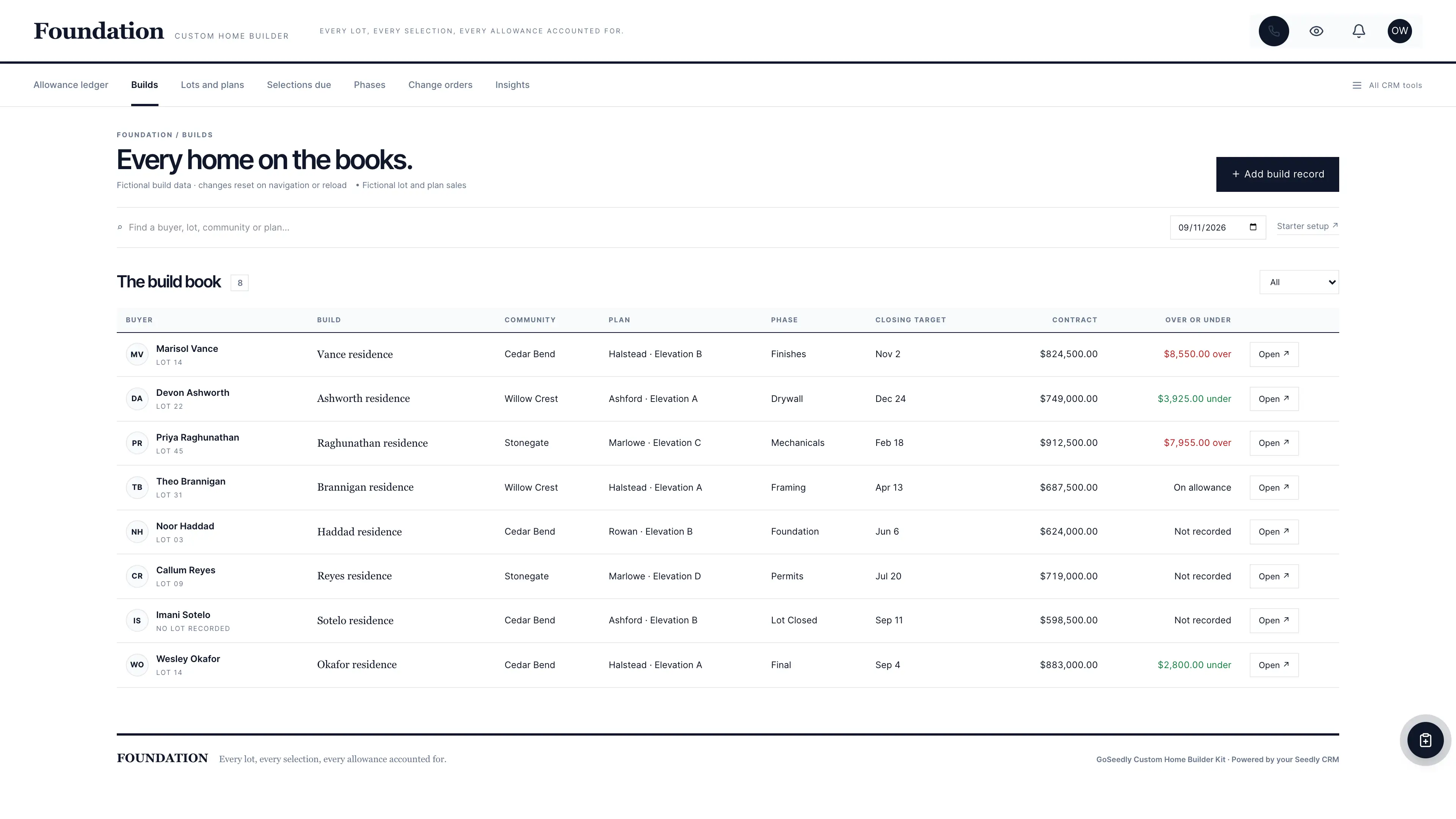
One table per pipeline: buyer, recorded lot and community, recorded plan and elevation, recorded phase, recorded closing target, the contract reference and the net over or under. Filter by recorded phase and open any build record.
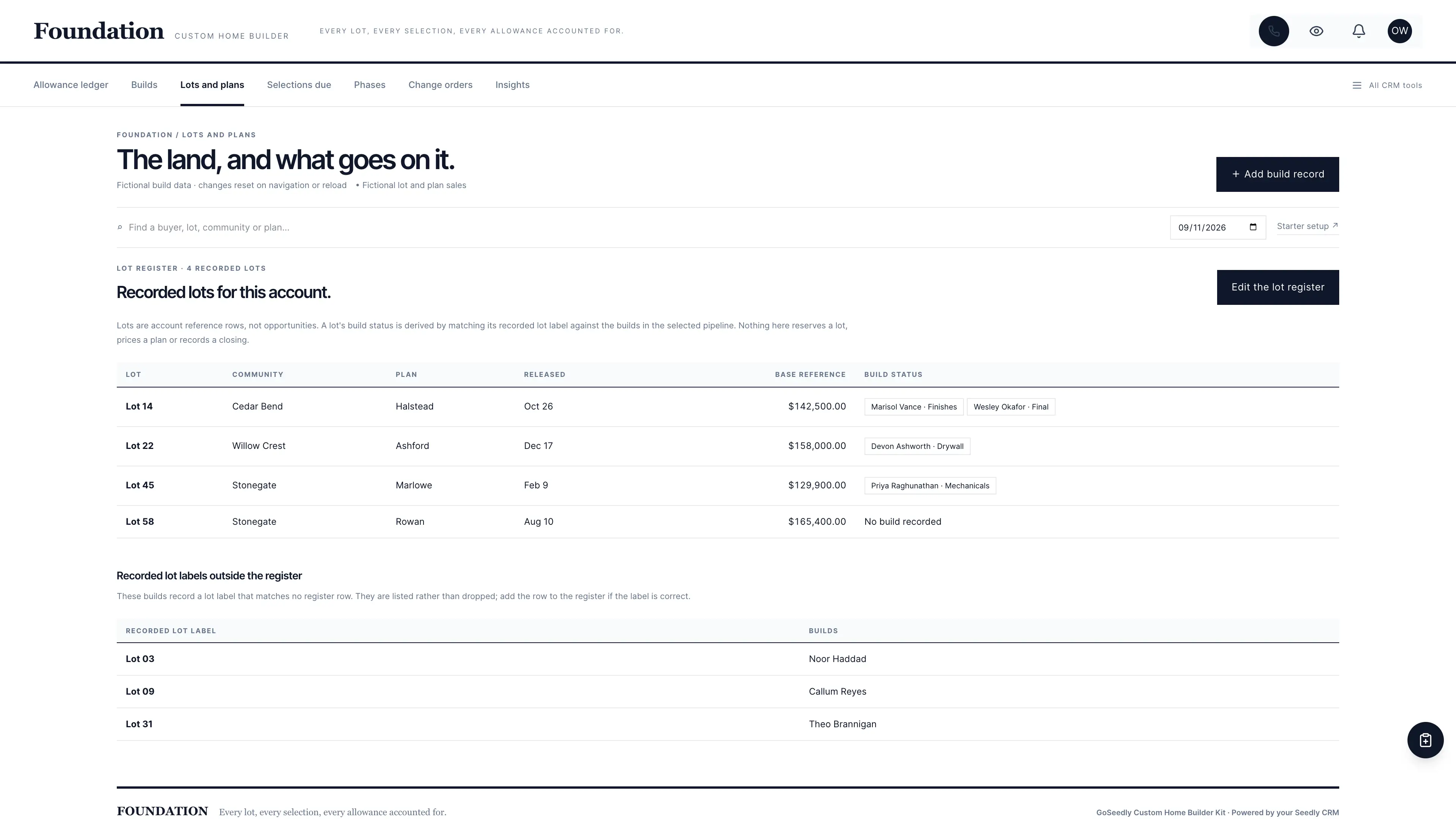
The lot register is account reference data, not opportunities. Each lot shows its recorded community, plan, release date and base reference, and its build status is derived by matching recorded lot labels after case folding. A lot with no match reads "No build recorded", and a typed label outside the register is listed rather than dropped.
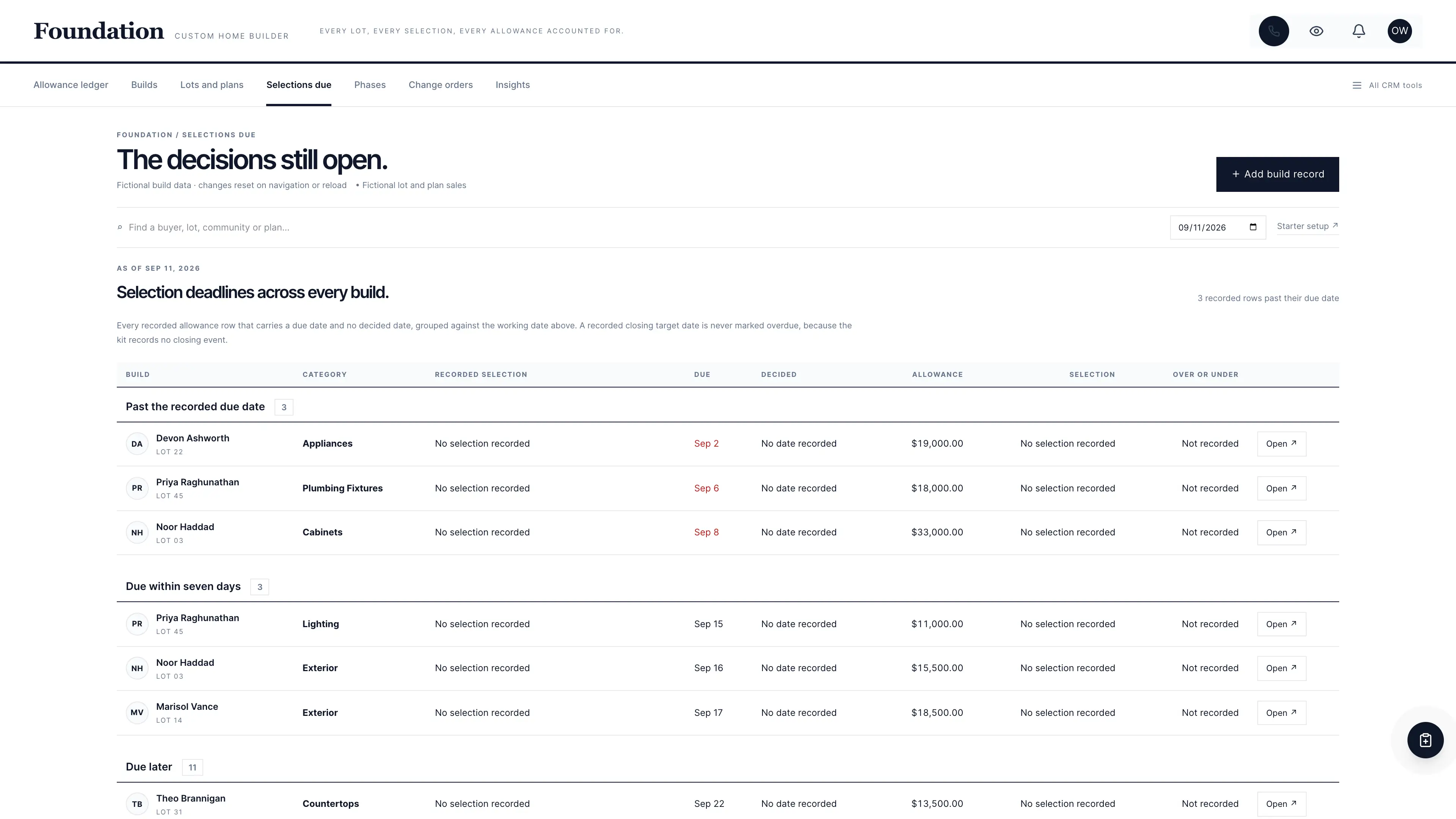
Every recorded allowance row that carries a due date and no decided date, banded against the working date: past the due date, due within seven days, due later, no due date, then the rows already decided. A recorded closing target date is never marked overdue.
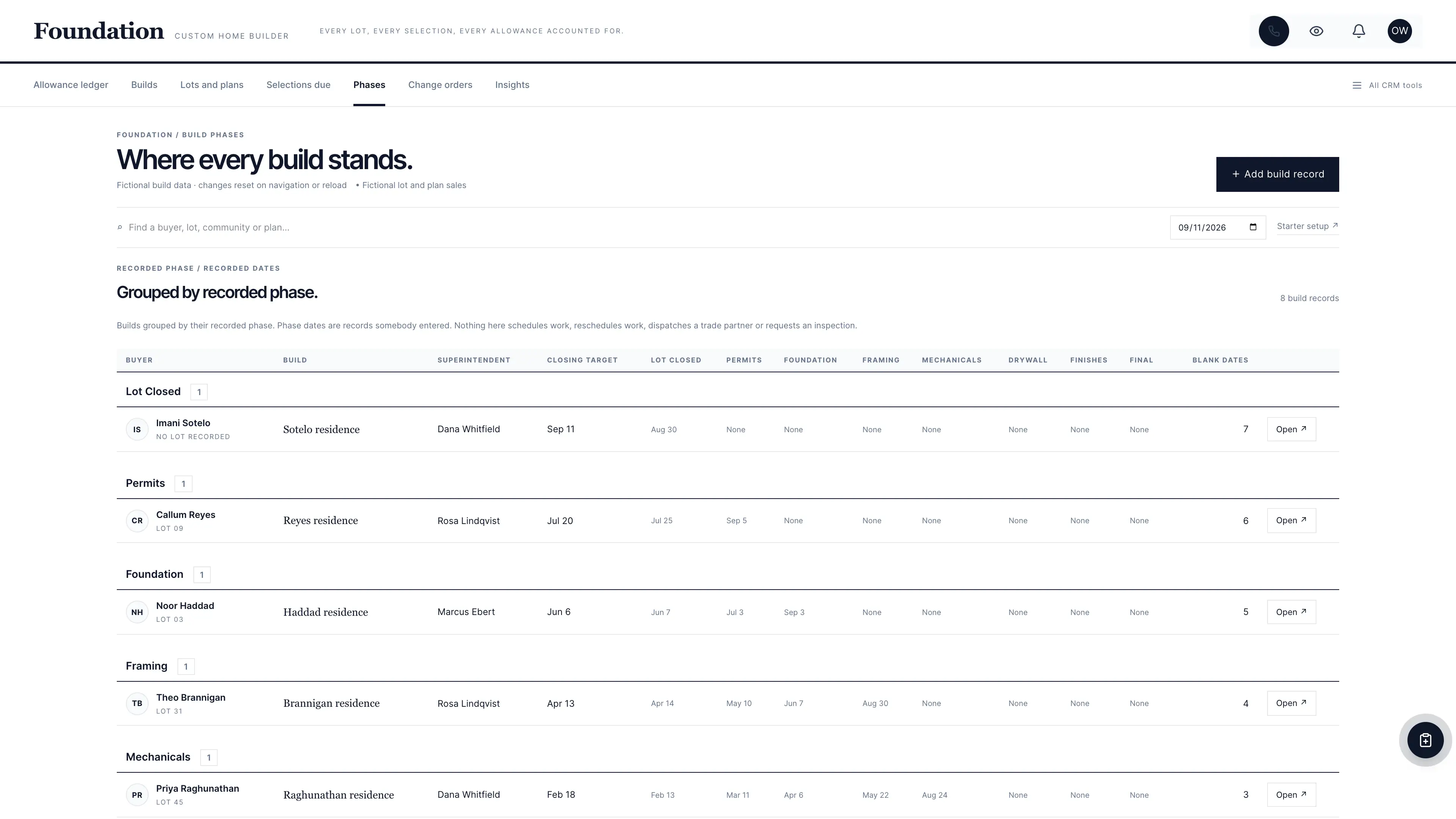
Builds grouped by recorded phase in phase order, with all eight recorded phase dates side by side, the recorded superintendent label, the recorded closing target and a count of phase dates still blank.
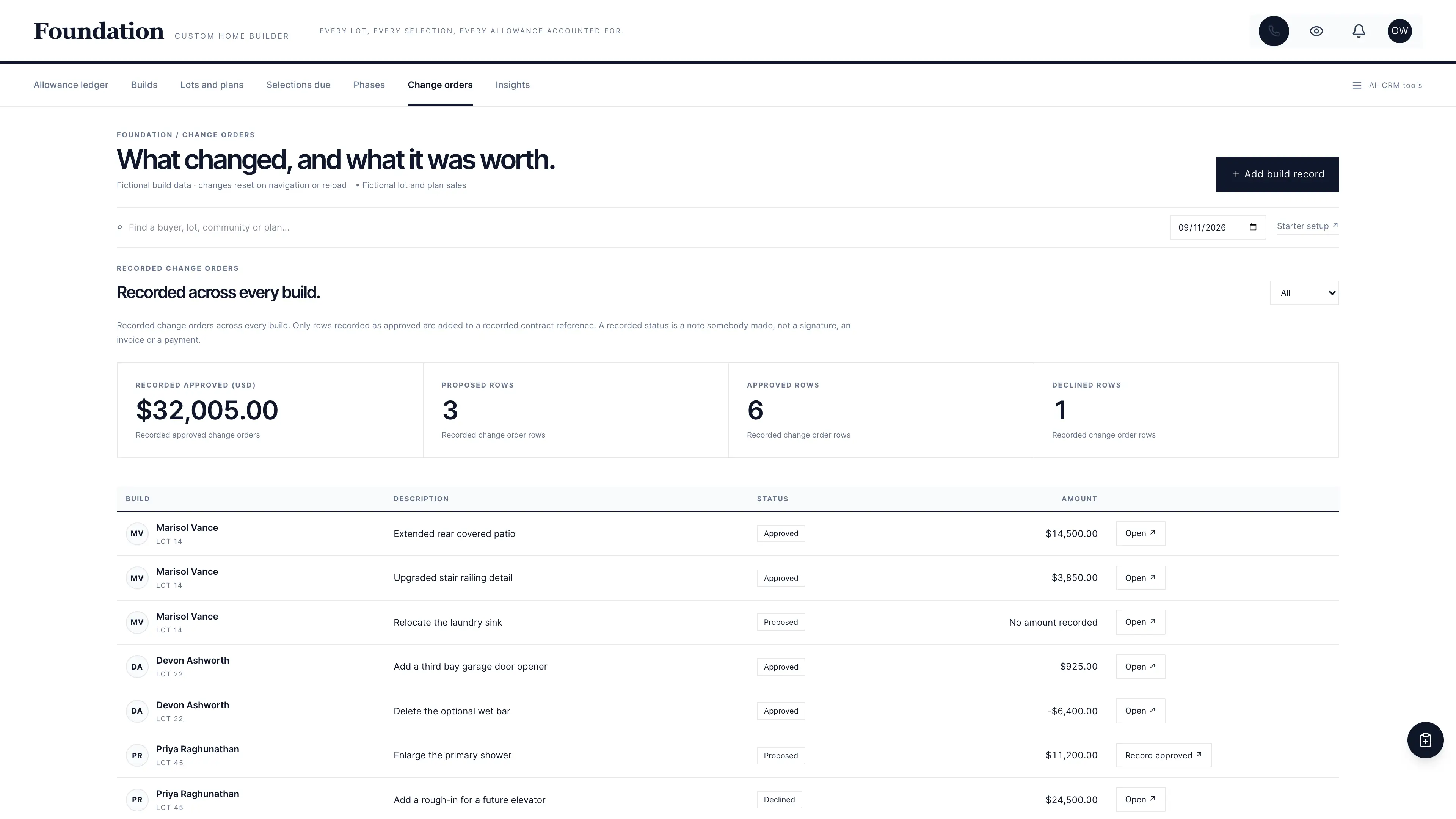
Recorded change orders across every build in status order, with recorded approved totals grouped by currency. Only rows recorded as approved are added to a recorded contract reference; proposed and declined rows are reported separately.
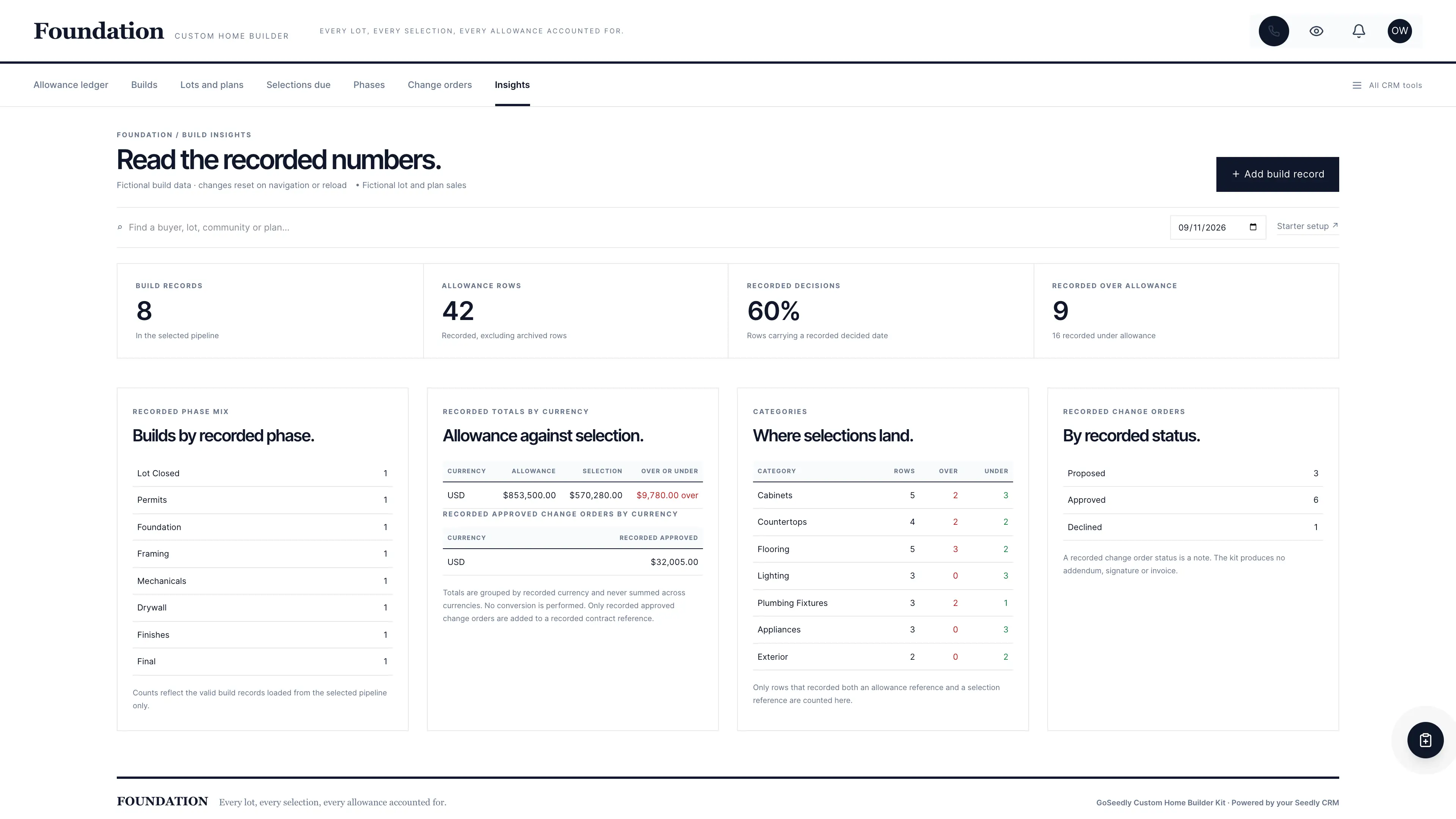
Build counts by recorded phase, the recorded selection decision rate, recorded allowance and selection totals grouped by currency, the categories most often recorded over their allowance, and recorded change order counts by status, for the selected pipeline only.
YOUR PROCESS, YOUR STARTING POINT
Useful structure. Only what you choose.
4 pipelines and 9 workflow drafts. Add the parts that match your work, with a separate sample view for exploring the interface.
01 / FOUR PIPELINES
Choose your starting structure.
Use a ready-made stage sequence or connect drafts to a suitable existing pipeline.
Lot and plan sales · 8 stages
Design and selections · 7 stages
Construction phases · 8 stages
Closing and warranty · 6 stages
02 / NINE WORKFLOW DRAFTS
Give the next step a shape.
Lot hold follow-up
Plan presentation prep note
Contract signed kickoff task
Selections kickoff task
Selection deadline reminder task
Over allowance review note
Phase inspection task
Pre-closing walkthrough task
30-day warranty check-in
Native trigger, task, wait, and note nodes provide editable examples. Every draft stays inactive until you review and publish it.
03 / SAMPLE WORKSPACE
Explore before adding records.
Explore eight fictional build records across the eight recorded phases, with 42 recorded allowance rows, ten recorded change orders and four recorded lot register rows. Two builds are recorded over their allowances. Example edits stay in the current page’s memory and reset on navigation or reload; sample builds and lots are never inserted into your CRM.
No sample customers are inserted into your CRM.
Starter setup checks selected kit additions before removal and preserves edited records and live work.
THE KIT, UNPACKED
Your workspace. Your starting point. Your code to edit.
One build is a native contact-linked opportunity with namespaced lot, community, plan and elevation labels, a contract reference, superintendent and selections coordinator labels, a recorded phase, one recorded date per phase, a closing target date, allowance rows and change order rows. The lot register lives in its own account settings key beside the starter receipt. Recorded references are never written into native opportunity value.
Allowance ledger with an over or under column and double-rule totals
Eight-cell recorded phase strip with recorded dates
Builds table, lot register and banded selection deadlines
Change orders with recorded approved totals by currency
Build insights drawn from recorded workspace data
White ruled-ledger Foundation application frame with full CRM tools
Four optional pipeline templates and nine inactive workflow drafts
Eight fictional in-memory build records, 42 recorded allowance rows and four recorded lots
Guided setup, compatibility report, and private rollback receipt
AI-agent documentation for customized installations
Original editable source, configuration, and tests
Run the guided setup from the extracted kit. Supported integrations can be installed directly; customized integration files get a reviewed merge.
02
Connect the required helper.
Deploy the included helper from your authoritative backend source before connected edits. Build your web app, then choose any optional pipelines and drafts you need.
03
Set up your own team.
Edit company name, descriptor, and default pipeline name. Sign in with your account and verify the workflows and permissions your team uses.
Compatibility and operational details
Seedly CRM 5.8.4 · extension API 1. Node.js 20 or newer. The installer checks supported integration-file versions and does not deploy your web app or backend. The included original build helper is required for connected creation, editing, the lot register and starter setup. It preserves native account permissions and unrelated custom fields, checks the captured timestamp and a server-owned revision before saving, and patches only its own account settings key. Deploy it from your authoritative backend source before connected edits. Pipeline presets and workflow drafts remain optional.
A recorded allowance is a number somebody typed. The kit does no estimating, takeoff, bid levelling, vendor pricing, job costing, draw scheduling or accounting. The over or under reference must equal the recorded selection minus the recorded allowance, and the server refuses a row where it does not; rows missing either reference are excluded from the net and counted, so a partial ledger is never reported as complete. Phase dates are records somebody entered: nothing schedules, reschedules, dispatches a trade partner, orders material, files a permit or requests an inspection. The recorded closing target date is a date, not a closing, and nothing in the kit contacts a buyer, a trade partner or a lender. Change order statuses are notes, not signatures, addenda or invoices. The recorded phase is separate from the native pipeline stage: saving a build never moves a card. Totals are grouped by currency and never summed across currencies.
Calling, messaging, signing, payments, and external integrations depend on your Seedly installation, account permissions, plan, and configured providers. Screenshots use sample data and reference imagery. Hosting, installation, and ongoing maintenance are your responsibility.
Checking access…
DEVLAUNCH ALL ACCESS
Every kit. And everything else.
DevLaunch All Access includes every GoSeedly CRM kit, all 195 available today, along with every class, course, and product we release, and private calls with Aaron.
All 195 CRM kits
Every published kit as original editable source, with optional pipelines, workflow drafts, and guided installers. Browse the kits
Every class, course, and product
The full DevLaunch library and software collection, plus each eligible release during your access year, added to your portal as it ships.
Private calls with Aaron
Bring the idea, the offer, or the bottleneck, and leave with a plan you can follow.
DevLaunch All Access
Want more than one kit? All Access covers the whole CRM kit library and the rest of what we make. See everything it includes on the All Access page.
For your own compatible Seedly CRM. Seedly software, hosting and installation services are separate. Each full-interface kit uses its own web installation.
BEFORE YOU MAKE IT YOURS
Good questions. Clear answers.
How do I receive the kit?+
Purchase securely through Whop. Your original source ZIP and installation documentation are delivered manually to the email used at checkout. This is a one-time purchase of this kit; Seedly software, hosting, and installation services are separate.
Does this include Seedly CRM?+
You obtain and configure Seedly separately. The kit adds original frontend screens, a shared theme, starter definitions, and integration instructions. It does not include Seedly’s codebase, license, hosting, or a separate CRM database.
Is this one connected workspace?+
Foundation keeps its build navigation across the original ledger views and native CRM modules. Full CRM tools remain available within the same signed-in account and application theme. Contacts, Calendar, Estimates, Documents, and other full modules retain the functionality supplied by your own Seedly installation. Existing authored content and provider screens retain their own layouts.
Can I use it with existing customizations?+
Yes, with a compatibility review. The installer checks the supported integration files. Changed integration files need a reviewed merge; the included AI-agent guide explains how to preserve custom extensions, permissions, providers, and routes.
Do I have to import all the starter content?+
No. Choose individual pipelines and workflow drafts, use a compatible existing pipeline, or install none. Workflows remain inactive until reviewed and published. They use native triggers, internal tasks, optional notes, and timed waits. A wait does not verify task completion or recheck the current stage. The included drafts do not send customer messages.
Can I remove the examples and starter content?+
Sample records stay in memory and never create customers in your CRM. Leave sample mode to return to your account. Starter setup lets you review removal of unused kit additions; server checks retain edited or published workflows and pipelines with live work or references. Removing the frontend does not delete account records.
Can different subaccounts use different kits?+
The current design and branding apply to the whole web installation. Subaccounts still separate data and access. Use a separate web installation for another full-interface kit; running different kit designs by subaccount in one installation requires additional customization.
Selected excerpts from reviews of DevLaunch training, software, and services. Individual customer experiences across DevLaunch.
Your privacy, your choice.
We use essential storage to keep the site working. With your permission, we also use analytics and the Whop Pixel to understand visits and advertising results. Optional analytics stay off until you choose.
 01 / Allowance ledger